

Circular City – Circular Construction – Heritage Conservation
There is now little dispute that a ‘construction revolution’ is urgently needed in terms of climate policy. However, this is not yet particularly evident in construction and planning practice, even though numerous concepts offer options for action. For the semester project in the winter semester 2022/23, we are taking up the theme of the winter school run by the collaborative project ‘Young Professionals Design the Future’ and focusing on the topic of the ‘circular city’. What does this mean, and what is meant by the key terms ‘urban mining’, ‘cradle-to-cradle’, ‘circular cities’, etc.? What do these concepts have in common, how do they differ, and what do they have to do with heritage conservation – or rather, what do they mean for it?
In the first third of the semester, we aim to address these questions, discuss current texts on the subject and critically analyse the various concepts. In the middle third of the term, we will examine the potential and, where applicable, the current status of the implementation of such concepts, using the city of Halle an der Saale as a case study. In the final third, the focus will then be on developing our own conceptual approaches.
The project will be accompanied by field trips and presentations. The field trip will take us to Berlin, where we will visit buildings, initiatives and projects in the field of the circular city and circular construction. Further information is available on the website of the professorship of Conservation and History of Architecture.
Time: Thursdays 9.15 am – 4.45 pm. Starts on 13 October 2022; venue to be announced. The excursion will take place in calendar week 44.
Introductory reading:
Felix Heisel, Dirk Hebel (eds.): Urban Mining and Circular Construction. The City as a Raw Materials Depot, Stuttgart 2021.
Material of the City. Material that has become a symbol, a symbol that has become material. *Der Architekt* 4/2020.
Announcement
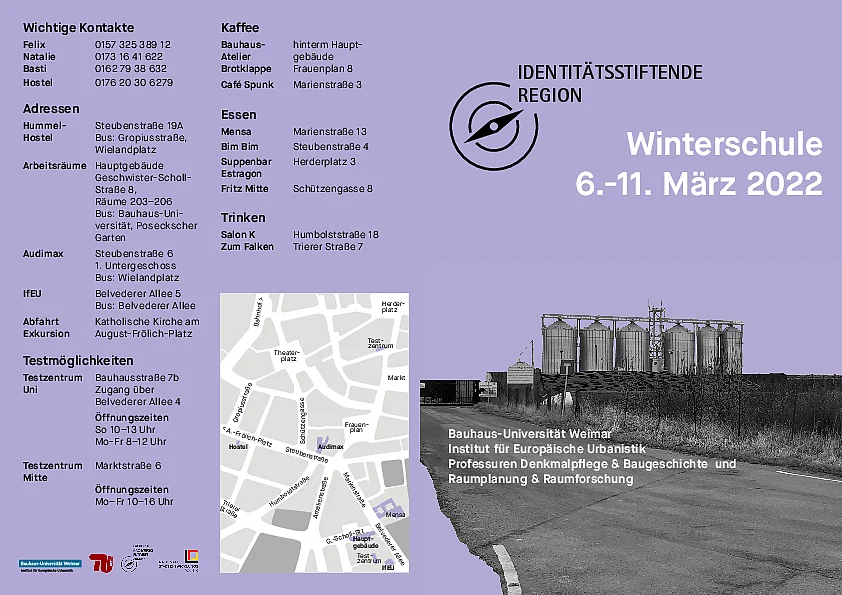
Staff and students on the ‘Urbanism’ degree programmes at the Bauhaus-Universität Weimar (Faculty of Architecture and Urbanism) have been taking part in the National Urban Development Policy University Days since 2009. In the regular courses each semester (including planning projects), students are given specialist training on current key topics. They then work intensively on conceptual ideas across universities during the so-called winter and summer schools. They present their findings during the University Days: in this way, student projects feed into the urban policy discourse.
The Bauhaus University has always participated in this series of events; this year, however, it is acting as host in Weimar. As part of this, the organisation of the 2022 Winter School was contractually transferred from the Technical University of Berlin to the Institute for European Urban Studies in Weimar. The professorships of Conservation and History of Architecture and Spatial Planning and Research took charge of the preparations, both in terms of content within their respective courses and in terms of organisation, with one coordinator per professorship.
The theme ‘The Identity-Forming Region – Possibilities and Limits of Regional Identity Formation’ will be explored in two planning projects during the 2021/22 winter semester (‘Industrial Landscapes’ and ‘Thuringia, the Green Heart of Germany’). Numerous German universities and planning degree programmes are also addressing issues of local identities.
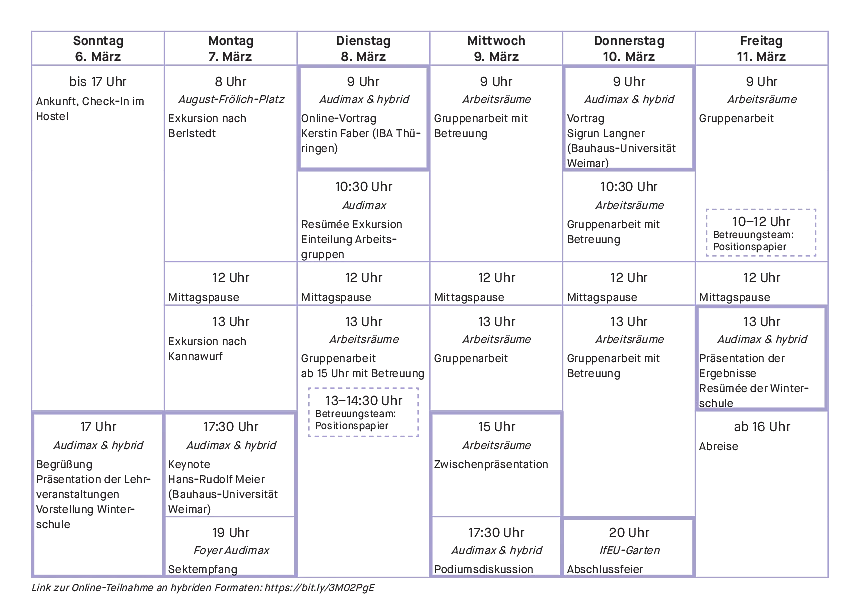
From 6 to 11 March 2022, the approximately 45 participants from eleven nationwide universities will take part in a week-long academic programme together. The programme includes presentations of the projects, an excursion to Berlstedt, a keynote speech and interdisciplinary presentations. In addition, workshops will be organised throughout the week to gain new insights directly through group work. The results will be presented to the public in early summer. We are eagerly awaiting the event and look forward to welcoming our guests to Weimar and to a lively exchange of ideas.
Further information about the project can be found here.
Press review
Thüringer Allgemeine: “Kannawurf as a region that fosters a sense of identity” (8 March 2022)
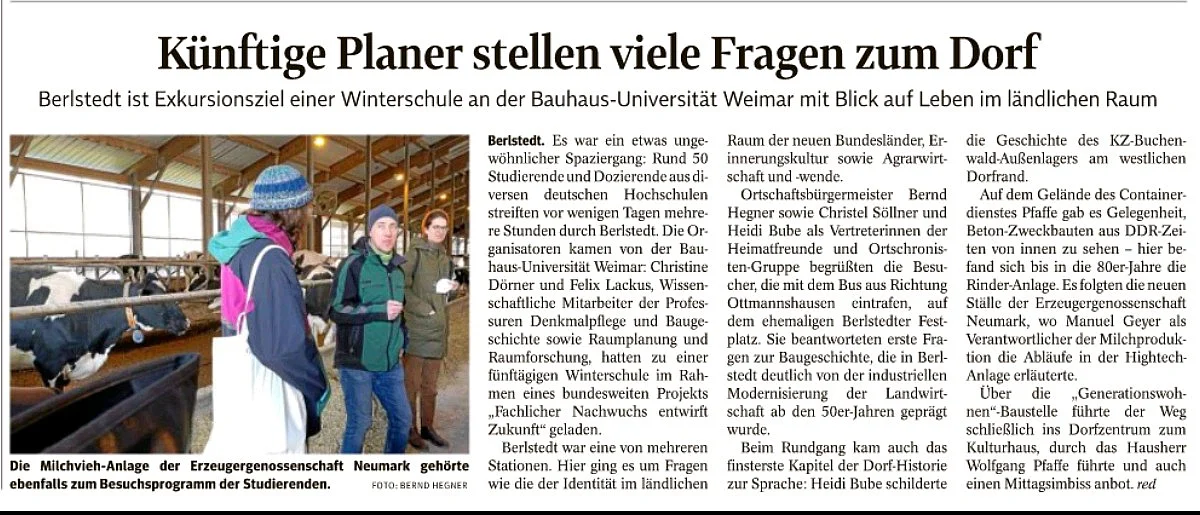
Thüringische Landeszeitung: “Future planners ask lots of questions about the village in Berlstedt” (10 March 2022)