


Factsheet European Urban Studies (M.Sc.)
The Master's programme is aiming at educating researchers in the field of urban studies. It will provide knowledge and academic skills to analyse, research and plan, particularly for students who want to start a professional career in urban planning, research and academic institutions and the wider field of civil society. The teaching programme intends to prepare for self-organised research projects and thereby for further studies (PhD) as well.
Academic education in the field of urban studies is
- research oriented
- European focused (courses taught in English language; European network for research experience)
- Transdisciplinary and comparative (combines urban design, urban planning, urban sociology, landscape planning and spatial planning)
and focused on
- Research on urban problems in contemporary cities in Europe
- Advanced knowledge in urban planning, urban sociology, urban design, landscape planning, spatial planning
- Research strategies and methods
- Intellectual framing on the international discourses in urban studies
- Personal academic development (also as a preparation for a PhD)
- Development of a European perspective on urban issues
- Transdisciplinary understanding of urban studies
The interaction of the different subject areas outlined below allows for a differentiated examination of various issues:
- European Cities
- Urban and Landscape Planning
- Urban Sociology
- Research Methods and Research Design
Eligibility
Graduates of architecture, landscape planning, regional/spatial planning, geography, social, political and cultural science, European studies and all related disciplines
Tuition Fees and Scholarships
There are no tuition fees but a semester contribution per semester which also covers the usage of public transport. As usual in any studies, additionally, some modules like the research project may require students to cover costs for excursions or a study trip (travel and overnight stay) during the semester.
For the master program „European Urban Studies“, you can apply for DAAD scholarships for academic disciplines, if your country is listed. Please see the list oft he countries and the conditions on following link: daad.de/go/de/stipa50026200
Please notice that the master program „European Urban Studies“ isn´t eligible from the DAAD scholarship „Postgraduate Studies in the Field of Architecture“. Applicants with this scholarship should apply for the design-orientated Urban Planning master-program INTEGRATED URBAN DEVELOPMENT AND DESIGN
Programme „European Urban and Planning Studies” (EUPS)
A Double Degree programme between the Master “European Urban Studies” at the Bauhaus-Universität Weimar and the Master “Strategic Spatial Planning” at the Blekinge Institute of Technology (BTH) Karlskrona, Sweden, will be initiated in the field of spatial planning and urban studies from October 2025. Interested students apply regularly in the Master “European Urban Studies” (deadline for Winter-Term 2025/26 for EU-Applicants: 25th June 2025) and notify in the letter of motivation, that they are interested to participate to the double degree EUPS. The letter of acceptance is provided in July 2025.
EUPS Organisation
Organisation of the Double Degree Study Program „European Urban and Planning Studies” (EUPS) (starting October 2025)
Participants of the programme are enrolled in the master program of their university, it means participants from Weimar are students from the Master-Program „European Urban Studies“. In the first year, students will follow the course programme from Weimar. The courses are run simultaneous, during two semesters. The modules “language course” and “electives” are recommended to learn the language of the country of mobility (DaF/Swedish), depending the country of origins. The second year is taking place in Karlskrona. The courses are taking place consecutive between August and January. The master module will take place remotely; its colloquium is organised in hybrid format. The core of the double degree is the co-supervision from one lecturer from Weimar and one examiner from BTH according the examination regulations.
Study Programme
The Master's programme is completed over four semesters and students are required to earn a total of 120 ECTS during the course of the programme. The Urban Studies programme focusses on the following six areas:
- Urban Planning
- Urban Studies and Social Research
- Urban Design
- Urban Architecture
- Landscape Architecture and Planning
- Spatial Planning and Research
Students are expected to obtain 30 ECTS credits each semester, a total of 120 ECTS. The first year will be spent in Weimar. The second year will consist of a semester abroad or in Germany working on an individual research project followed by a period of research and thesis writing in the forth semester.
- compulsory courses on European cities (12 ECTS)
- compulsory courses on Urban and Landscape Planning (12 ECTS)
- compulsory courses on Urban Sociology (6 ECTS)
- two compulsory research methodology courses culminating in a research exposé (6 ECTS)
- a comparative study project with an integrated research training in cooperation with a European partner university (12 ECTS)
- a language course in a European Language (not English) (3 ECTS)
- electives courses (9 ECTS)
- a research project abroad or in Germany (27 ECTS)
- project supervision (3 ECTS)
- the thesis (30 ECTS).
The first and second semesters of the curriculum are designed to prepare students with in-depth scientific and subject-related knowledge within the field of European urban studies. Students are also encouraged to come up with their own research topics. The courses are taught in English, but students also learn another European language. The programme's European focus is supported by courses that deal with questions of European urban development, both generally and in certain individual cities in particular.
The second semester consists of a study project based on a common interdisciplinary research issue in cooperation with a European partner university. The semester is organized as a study project and allows students the opportunity to put the scientific and empirical research methods learned in the first semester into practice.
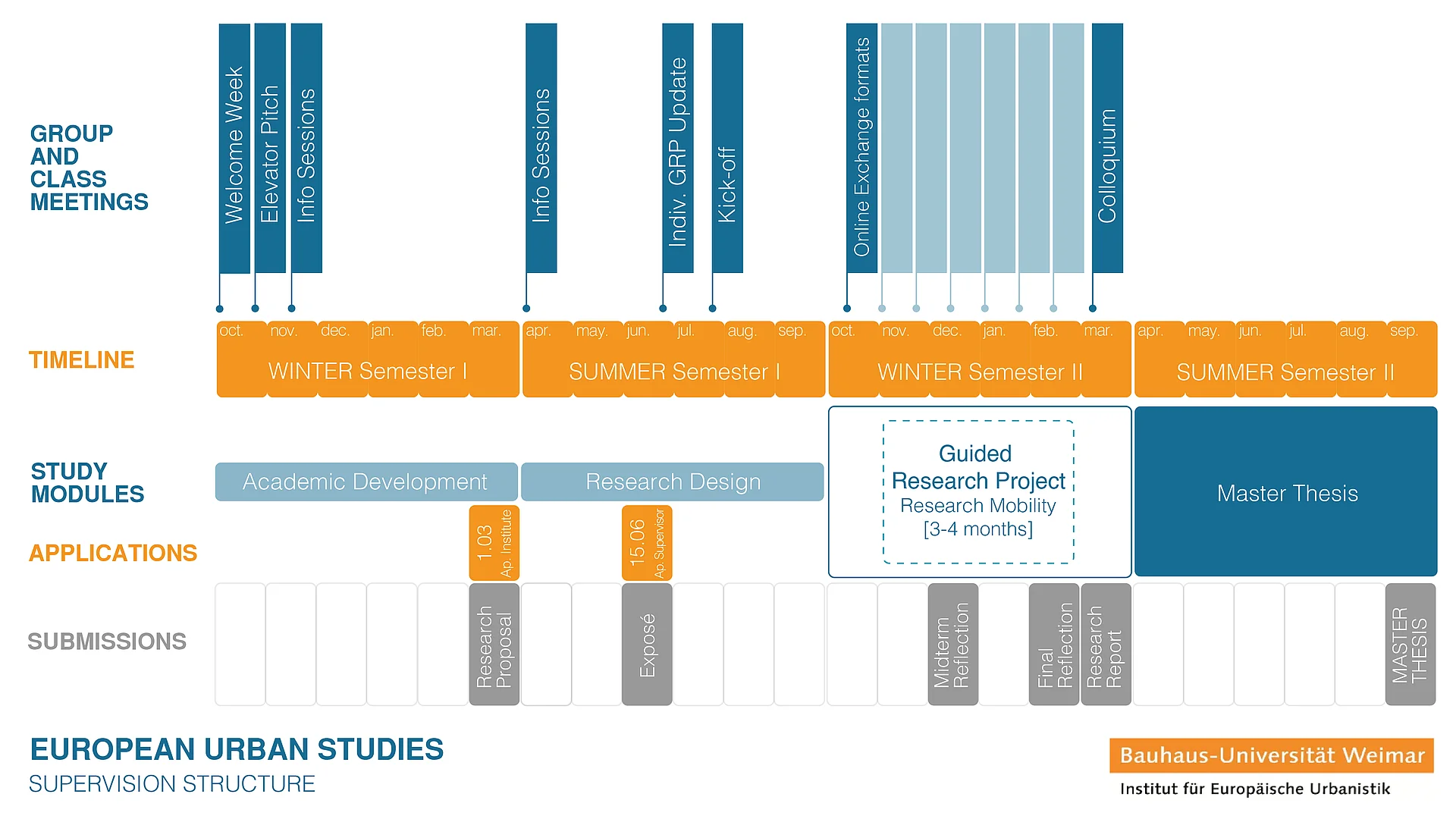
The third semester consists of an individual research project done through the Institute for European Urban Studies (IfEU) and can be carried out either in Germany or in another European country. Students must submit an exposé and plan for this research project by the end of their second semester. The exposé and plan must be approved by the supervising professor. The IfEU offers support in arranging contacts for field research in Germany and abroad, but the primary responsibility lies with the student.
In the fourth semester, students prepare their Master’s thesis. By this point, students have acquired the necessary basic empirical research skills through the »Academic Development« modules (1st and 2nd semesters) and the »Guided Research Project« module (3rd semester), which make up the curriculum. There is a significant thematic and methodological overlap between the 3rd and 4th semesters. Because of this, students are able to use their Master’s thesis to substantiate the findings from their individual research projects and integrate them into the academic discourse. The individual research projects consist of an introspective research project and the presentation of this project in the colloquium. The Master’s programme concludes with the scientific Master’s thesis and the oral Master's examination.
Successful candidates graduate with the »Master of Science« (M.Sc.) title. Please note: This degree programme does not qualify graduates for inclusion into the German national register of architects and urban planners (Bundesarchitektenkammer).
Application Deadlines
The European Urban Studies (M.Sc.) study programme is an English-speaking programme with a strong orientation towards research and theory. It is offered by the Institute for European Urban Studies (IfEU).
The application deadline for "European Urban Studies (M.Sc.)" for the winter semester, which begins in October of the year for applicants from the European Union including Switzerland is 25 June of the year.
The application deadline for "European Urban Studies (M.Sc.)" for the winter semester, which begins in October of the year for non-EU students is 15 May of the year.
Application Procedure for EU Students (incl. Switzerland)
Prerequisites
Prerequisites
Before you apply for the Masters programme, please check whether you fulfil the formal requirements for admission.
You are eligible to study the Masters programme if you
- have obtained a university degree (or similar) from a German or an international University with at least 180 CP in the disciplines of architecture, landscape architecture, urban planning / regional planning, urban design, geography, urban sociology, political, social and cultural sciences, European studies and all related disciplines. In case of doubt, the examination board determines upon qualification. For this programme, a minimum grade of 2,5 according to the German grading system is required.
- can refer to a certain level of academic or professional experience shown through adequate works samples, text-based and visual, as well as through sample from your previous studies.
- have an advanced level of English language skills.
Application Documents
Application Documents
In order to apply for admission to the programme, you need to hand in the following documents and material:
! Please not that all documents are submitted online through the portal (no hard copy for the application)
- Completed form from online-application *students from EU countries only (access Bauhaus.CampusPortal)
- Motivation letter
The motivation letter is a very important part of the application procedure. Please prepare it with great care! Your motivation letter (in English, up to 6,500 characters with spaces) should focus on the following points:
What is your motivation for applying to the study programme European Urban Studies? (Why are you interested in the study programme ? What are your plans for the future and how should this study programme help you achieve your goals?)How does your educational and professional background relate to the study programme? (What makes you a good candidate for this programme? What knowledge, skills and experiences do you have that are relevant to this programme?)What are your specific research interests within the field of Urban Studies? (What issues are you most interested in? What problems would you like to examine in more depth? What would be a possible topic for your Master thesis? Do you want to develop a planning focus within the double degree EUPS?) - Essay
Please submit an essay reflecting on urban issues or your own publication within the field. The essay should not exceed 3,000 characters, including spaces. Feel free to draw inspiration from a relevant urban studies book or author and share your insights on their work. - Certificate of qualification for university entrance | copy
- University degree or similar qualification including all relevant study results (courses and grades) | certified copy
Documents not in German or English need to be submitted in a certified translated version, in German or English. - Proof of English language proficiency according to B2 (minimum) of the Common European Framework of Reference (CEFR) for Languages
Your CV- You are free to add additional documents like recommendation letters, work references, etc.
- If you want, additionally, you are invited to include a PDF file with samples from your previous study or professional work (portfolio) related to relevant fields of studies. The file may consist of works from your previous or current studies, from internships, from previous career, self-initiated projects, publications and/or volunteer work. We appreciate a short description of the projects in the portfolio. Please submit all samples in one single PDF file labelled with your last and first name through Uni-Assist. We appreciate portfolios that do not exceed 6 MB.
Admission and further steps
Admission and further steps
You will be informed on the results latest early in August. Due to the high number of applications, you are kindly asked to please abstain from contacting us regarding the results. You will be informed as soon as the examination board has finished its work.
If your application was considered positively, you will soon after also receive the official admission letter from the university. This document enables you to conduct all the administrative affairs such as visa-issues etc. And it is the precondition in order to enroll to the University for your Master Programme. Only after having enrolled, you actually become a student of the programme. It is only possible to start your studies in winter term.
Application Procedure for Non-EU Students
Prerequisites
Prerequisites
Before you apply for the Masters programme, please check whether you fulfil the formal requirements for admission.
You are eligible to study the Masters programme if you
- have obtained a university degree (or similar) from a German or an international University with at least 180 CP in the disciplines of architecture, landscape architecture, urban planning / regional planning, urban design, geography, urban sociology, political, social and cultural sciences, European studies and all related disciplines. In case of doubt, the examination board determines upon qualification. For this programme, a minimum grade of 2,5 according to the German grading system is required.
- can refer to a certain level of academic or professional experience shown through adequate works samples, text-based and visual, as well as through sample from your previous studies.
- have an advanced level of English language skills.
Application Documents
Application Documents
Dear international students, the content of the web pages is currently being revised. Please follow the information in UniAssist. All modalities have been already updated there. Please contact the academic advisor of the respective study program in case of question
In order to apply for admission to the programme, you need to submit the following documents and material through Uni-Assist which you will first need to register for as it is explained in the paragraph "Application Procedure" which you find further down on this page.
Letter of motivation | signed
The motivation letter is a very important part of the application procedure. Please prepare it with great care! Your motivation letter (in English, up to 6,500 characters with spaces) should focus on the following points:
What is your motivation for applying to the study programme European Urban Studies? (Why are you interested in the study programme ? What are your plans for the future and how should this study programme help you achieve your goals?)
How does your educational and professional background relate to the study programme? (What makes you a good candidate for this programme? What knowledge, skills and experiences do you have that are relevant to this programme?)
What are your specific research interests within the field of Urban Studies? (What issues are you most interested in? What problems would you like to examine in more depth? What would be a possible topic for your Master thesis?)
- Essay
Please submit an essay reflecting on urban issues or your own publication within the field. The essay should not exceed 3,000 characters, including spaces. Feel free to draw inspiration from a relevant urban studies book or author and share your insights on their work.
University degree or similar qualifications including all relevant study results (courses and grades) | certified copy
Documents not in German or English need to be submitted in a certified translated version, in German or English.Certificate of qualification for university entrance | copy
Proof of English language proficiency according to B2 (minimum) of the Common European Framework of Reference (CEFR) for Languages
Your CV
You are free to add additional documents like recommendation letters, work references etc.
If you want, additionally, you are invited to include a PDF file with samples from your previous study or professional work (portfolio) related to relevant fields of studies. The file may consist of works from your previous or current studies, from internships, from previous career, self-initiated projects, publications and/or volunteer work. We appreciate a short description of the projects in the portfolio. Please submit all samples in one single PDF file labelled with your last and first name through Uni-Assist. We appreciate portfolios that do not exceed 6 MB.
Application Procedure
Application Procedure
Once you have made sure that you fulfil the prerequisites and are eligible to apply to the Masters programme "European Urban Studies (M.Sc.)", you can now proceed to apply through uni-assist.
Registration
In order to start the application process go to the following link to register with uni-assit.
You will be asked to provide your personal information and to create an account for further use. Once you have entered all information you will be sent a link that will activate your account.
Login & Further Information
As you activate your account, you'll be asked to enter further details. With that step taken, you will then be able to search for the Masters programme "European Urban Studies (M.Sc.)".
Study Offers
This search mask allows you to narrow down your search for the Masters programme you wish to apply for. Enter for example the name of the university and choose Master as the degree you wish to obtain.
Create Application
Once you have choosen the right programme, it is time to create your application. In order to do so, you will be asked further questions. After you have uploaded all necessary documents, you are then asked to print off your form and to submit it online.
Please follow the instructions given by uni-assist. If there are any questions, please check out the following site: https://www.uni-assist.de/en/faqs/
Please note: There is no need to send hardcopies to our University or uni-assist. The application process is only taking place online.
Admission and Further Steps
After successful application and admission
After successful application and admission
You will be informed on the results the latest early in August. Due to the high number of applications, you are kindly asked to please abstain from contacting us regarding the results. You will be informed as soon as the examination board has finished its work.
If your application was considered positively, you will soon after also receive the official admission letter from the university. This document enables you to conduct all the administrative affairs such as visa-issues etc. And it is the precondition in order to enroll to the University for your Master Programme. Only after having enrolled, you actually become a student of the programme. Further information is available here . It is only possible to start your studies in winter term.
Guided Research Project
Core element and unique feature of the Master's programme European Urban Studies is the Guided Research Project (GRP). The GRP is an individual research project which is conducted as part of an exchange with a research institution in Germany or abroad in the third semester.
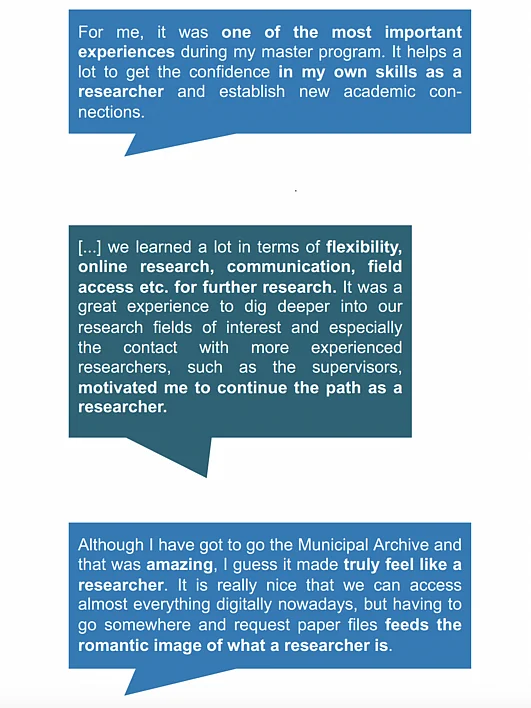
The following movie from 2022 is a collection of interviews with current students about their experiences during the Guided Research Project:

Camera and cut: Steven Mehlhorn
Interviewer: Lydia Finzel
Interviewees: Begüm, Charlotte, Franziska, Lisa, Matilde, Paul
GRP-Partnership
GRP-Partnership
Blended Learning Concept
Blended Learning Concept
During the course of the first and second semester the students will be equipped with the background knowledge and academic skills to develop a research question, to prepare a research design and to conduct field work. The GRP is therefore not only a possibility to follow personal research interests, but also to gain first experiences in working in a scientific context and to enhance individual project management skills.
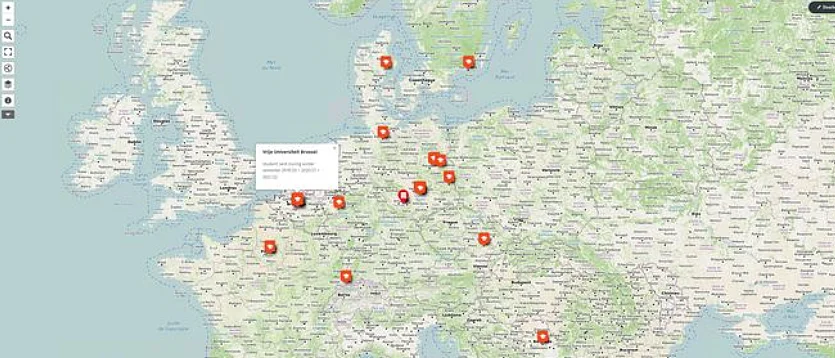
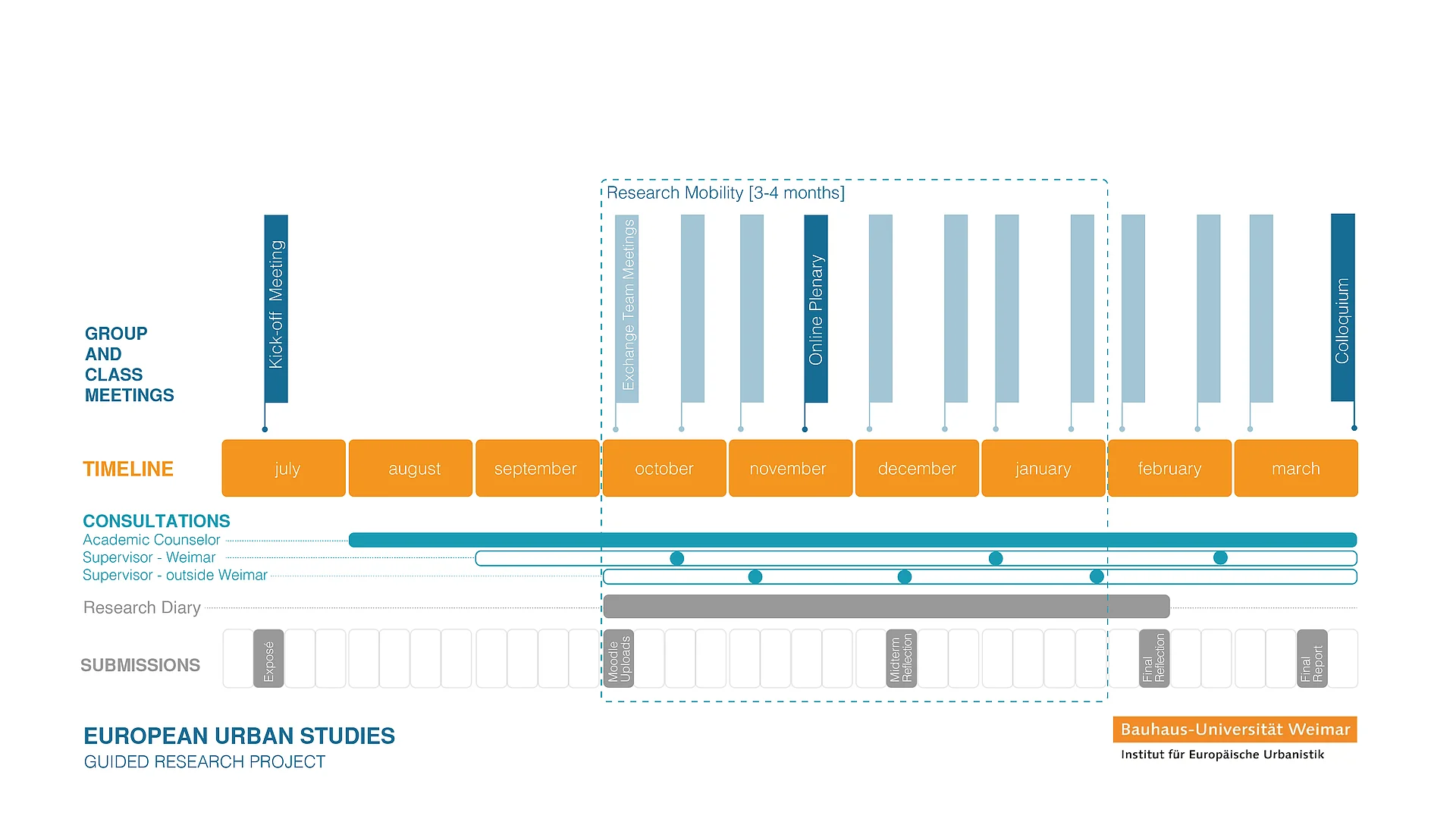
Throughout the whole GRP, the IfEU guides and supports the students before, during and after the research mobility. In order to allow the students to work on a research topic of their interest, the well-established scientific connections of the institute and a database with European partner universities and institutions help the students to find a suitable destination. Furthermore, the GRP is embedded in preparatory seminars, recurrent consultations and a mix of in-class meetings and online classes. Study groups will help the students to stay connected and learn from each other’s experiences during the individual research semester.
Supervision
Supervision
Questions about the Study Programme?
Dr. Elodie Vittu
Fachstudienberatung European Urban Studies
Prof. Dr. Frank Eckardt
Studiengangsleiter Master European Urban Studies
FAQs
1. Which Bachelor programmes are eligible for applying to this Master's programme?
1. Which Bachelor programmes are eligible for applying to this Master's programme?
Our Master‘s programme is an interdisciplinary study programme and therefore open to various study backgrounds. Currently, we have students with a background in the social sciences, architecture, urban planning, cartography, geography, building engineering, social work, ethnography and also history. However, it is important that your previous university degree qualifies you for a profession in a spatial planning discipline. Therefore, it is one of the prerequisites that applicants for the Master‘s programme should have studied „space-related“ subjects. This means that previous experiences in topics related to urban studies in general, such as urban research, urban sociology, housing research, mobility and infrastructures, human geography, or architecture and urban design, are beneficial for a successful admission.
2. What are the criteria for language proficiency?
2. What are the criteria for language proficiency?
The Master‘s programme European Urban Studies is an English-taught programme. All compulsory courses, as well as most elective seminars are held in English. The proof according to CEFR-B2 (minimum) can be a TOEFL-test, Cambridge Certificate, (First Certificate FCE), Grade C, IELTS, Band 6,0 (it means 6 or more) or any Certificate with CEFR-B2. Apart from a language certificate, we also consider proof issued by your faculty confirming that your entire Bachelor's study was conducted in English and that you demonstrated English proficiency throughout the programme.
3. Do I need a high score to apply for this programme?
3. Do I need a high score to apply for this programme?
The overall grade of the first university degree is converted into points. In the application assessment, the highest achievable points by grade are 60. The letter of motivation counts in total as 40 points in the overall application assessment. Depending on the quality of and your personal skills outlined in your letter of motivation, you can reach the minimum required 80 points out of 100 points to be assigned in the selection process. You can have a look at the study regulation from 2018 for an orientation about the detailed requirements and assessment criteria here.
4. How important is portfolio in the application process?
4. How important is portfolio in the application process?
While a portfolio is an optional component in the application package, the motivation letter and essay carry greater importance and take precedence over the portfolio in the evaluation process.
5. Is it possible to obtain a scholarship, and what other options are available to finance my studies?
5. Is it possible to obtain a scholarship, and what other options are available to finance my studies?
We don´t provide any financing opportunities. An exception is your research mobility in the 3rd semester, where we offer support with ERASMUS scholarships.
6. How long is the letter of acceptance valid?
6. How long is the letter of acceptance valid?
It is valid for 2 academic years, so if you got accepted in July 2023, you can enrol in October, 2023 or in October, 2024.
7. Is it possible to start the study in the summer semester (March)?
7. Is it possible to start the study in the summer semester (March)?
No, for M.Sc. EUS you can enrol and start your study only in the winter semester, so only in October.
8. When will the results of the selection process be announced?
8. When will the results of the selection process be announced?
Typically, the results are announced between the middle and the end of July.
9. Can there be a delay in the application process?
9. Can there be a delay in the application process?
The documents of non-EU students are being collected and processed by the third party (uni-assist), which can take time, so we recommend applying earlier than one week before the deadline.
Questions about the Study and Examination Regulations?
Katrin Sonnet
Examination Office
Prüfungsausschuss Master EUS