Lectures & Exercises
Computer Science for Engineers Winter term
The lecturers provide an overview of the fundamentals of computer science in engineering (basic concepts of programming and modeling, including classes and objects, methods, control structures, exception handling, input/output, data structures, algorithms, etc.), software design, an introduction to database systems, logical database design using the relational model, conceptual database design, relational query languages, physical database design, data integration, advanced concepts, and exemplary applications in construction informatics.
Further information is available in Bison.
Deep Learning in Computational Mechanics Winter and summer term
Basic concepts of machine learning; neural networks; physics-informed neural networks (PINNs), PINN variations (deep energy method, variational PINNs, weak adversarial networks) and extensions; dimensionality reduction; reduced-order models; Sparse Identification of Nonlinear Dynamical Systems (SINDy); clustering; material modeling with neural networks (physics-augmented neural networks); generative artificial intelligence in computational mechanics (autoencoders, generative adversarial networks (GANs), diffusion models, and transformers); inverse problems such as non-destructive testing, topology optimization, or model discovery; discussion and insights into current literature.
Further information is available in Bison.
Finite Element Methods Winter term
Finite element methods: (50% of semester course time)
Strong and weak form of equilibrium equations in structural mechanics, Ritz and Galerkin principles, shape functions for 1D, 2D, 3D elements, stiffness matrix, numerical integration, Characteristics of stiffness matrices, solution methods for linear equation systems, post-processing and error estimates, defects of displacements based formulation, mixed finite element approaches.
More Information in Bison.
Basics of FEM Winter term
Key focus areas include:
- FEM for one-, two-, and three-dimensional problems in elastostatics
- Locking, mixed and hybrid FEM formulations
- Beam elements (Timoshenko and Euler-Bernoulli beams)
- Plate elements (Mindlin-Reissner and Kirchhoff plates)
- Introduction to FEM programming with MATLAB
More information is available in Bison.
Geometric Modeling and Technical Representation Summer term
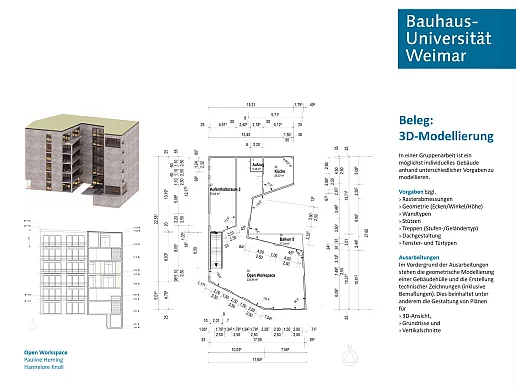
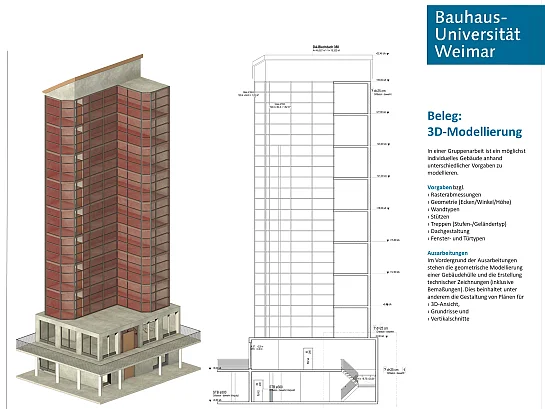
The course teaches the fundamentals of descriptive geometry. Using built construction projects as examples, it covers the theoretical foundations of geometric modeling and technical drawing. In the final part, students model detailed solutions of the project on the computer using a CAD system, with the emphasis on 3D modeling followed by the creation of drawings.
Further information is available in Bison.
Applied Finite element methods Summer term
Weitere Informationen im Bison.
Study Projects
Surface Modeling under Uncertainty Winter term 2026/2027
The fatigue life of an additively manufactured metal part produced by PBF-LB/M mainly depends on the roughness of the outer surface. It has been shown that capturing the surface exactly by means of surface scanning can predict the failure location and has been validated by cyclic testing of specimen. The results are assembled into an S-N curve to predict the fatigue life of future parts.
However, a robust prediction of fatigue life depends on hundreds of parts being manufactured and tested in different load regions. Often this is unfeasible due to the large number of required specimens. This is where numerical testing can assist cutting down on the number of required experiments.To this end, the generation of artificial surfaces to enhance the experiments that consider the characteristics of existing surface scans, is a promising approach. Each student is assigned one family of deep generative models (e.g. variational autoencoder, diffusion model, generative adversarial network) and works as a team member to answer the following questions:
- How big and what characteristics do the surface features have? How can these characteristics be described?
- How realistic are the generated surfaces, and how can this be measured?
- Which model family reproduces the variation of the real surfaces best, without copying the training data?
- Can the generation of 1-D profiles be expanded to higher dimensions?
Over twelve weeks each student first delves into the theory of their model family on a toy example, programming it from scratch before relying on libraries. The students will then be given 1-D profiles of scanned surfaces, analyse them statistically, generate new ones, and measure how realistic their generations are. Finally, the students investigate how the generation can be expanded to higher dimensions.
Deliverables are reproducible code and a final presentation.
More info in Bison.
Generative Modeling with CAD Winter term 2025/2026
This project will explore the possibilities of generative CAD modeling. The following steps are envisioned but may be changed upon mutual agreement with the supervisors
- Comprehensive literature study highlighting approaches of Generative CAD modeling
- Evaluation of existing approaches with freely available code (such as e.g. https://github.com/ChrisWu1997/DeepCAD )
- Suggestions for integration of side conditions such as mechanical stiffnesses
- Implementation
More Info in Bison.
Spannungsberechnung auf Basis von CT-Scans Winter term 2025/2026
The special project addresses the following four aspects:
FFT method [single]:
The first student will be given an existing implementation of the FTT method and corresponding literature. The student will then
- Carry out a literature review
- analyze the computational complexity of the method analytically and for practical examples.
- analyze pros and cons of the method
- propose, rewrite and implement remedies
Finite Cell Method (FCM) with Moment Fitting [single]:
The second student will be given an existing implementation of the moment fitting method for a 2D finite element case and corresponding literature. The student will then
- Carry out a short literature review
- Analyze the computational complexity of the method analytically
- Understand and implement the moment fitting method in FCM and analyze the computational complexity
Pre-Integration [single]:
The third student will work on implementing a pre-integration technique. Additionally, the student will prepare a given FEM framework for a meaningful comparison of the homogenization methods of student one and two. The tasks include:
- Carry out a short literature review
- Analyze the computational complexity of the method analytically
- Implement the pre-integration method and analyze its computational complexity
- Prepare an interface to include the methods of student one and two.
[team]:
The three students will then jointly compare their results on benchmark examples in a written report and present their findings in a final presentation. The modified codes must be handed in along with the technical report.
More info in Bison.
Daten zu Design: Strukturmaterialien Summer term 2026
This project-based course focuses on the integration of AI in material science, by utilizing machine learning and deep learning to model and design materials with targeted mechanical properties.
Students gain hands-on knowledge towards:
- Building predictive models
- Comparing feature encodings
- Performing sensitivity analysis
- Evaluating performance under limited data, uncertainty and out-of-distribution conditions
This course progresses from classical machine learning models to ensemble methods and deep neural networks, with an emphasis on representation learning, uncertainty-aware modeling and robustness.
In the final phase, students will apply their trained models to inverse design problems to search for material compositions that meet target performance constraints.
The final outcome includes a reproducible code repository, a technical report, and a final presentation summarizing methods, results, and design insights.
More info in Bison.
Entwicklung einer Image-to-Analysis Pipeline zur Abbildung von Bruchprozessen Summer term 2026
Additively manufactured (AM) concrete parts with selective cement activation are prone to defects, heterogeneity and brittle fracture. To enable reliable application and structural design of such parts, it is essential to understand their failure behavior. To this end, AM specimen where manufactured, excavated, dried and tested for their limit load.
The goal of the special project is to design and image-to-analysis pipeline to numerically model these experimental tests using the finite cell method (FCM) in combination with the phase-field approach to fracture.
Each student is provided with:
- A C++ finite element framework
- One CT scan of an AM concrete specimen
- Experimental data form three-point bending tests
[single]
The objective is to identify suitable numerical parameters of the phase-field model to reproduce the experimentally obtained limit loads. To achieve this, each student will:
- Conduct a literature review on the phase-field approach to fracture and the FCM to determine relevant numerical / material parameters.
- Process and modify CT scan data for numerical analysis.
- Develop an analysis pipeline to enable the analysis of CT scans using the FCM in C++.
- Perform a parameter study to match the simulation results to the experimental results and obtaining the phase-field parameters.
[team]
The students will then compare their results and jointly further develop this analysis pipeline to be provided as a Python library, allowing future researchers to perform similar analyses independently.
The results will be presented in a final presentation. The developed code must be submitted with a technical report.
The goals mentioned above will be adjusted to the capabilities and background of the students (Bachelor/Master).
More info in Bison.