

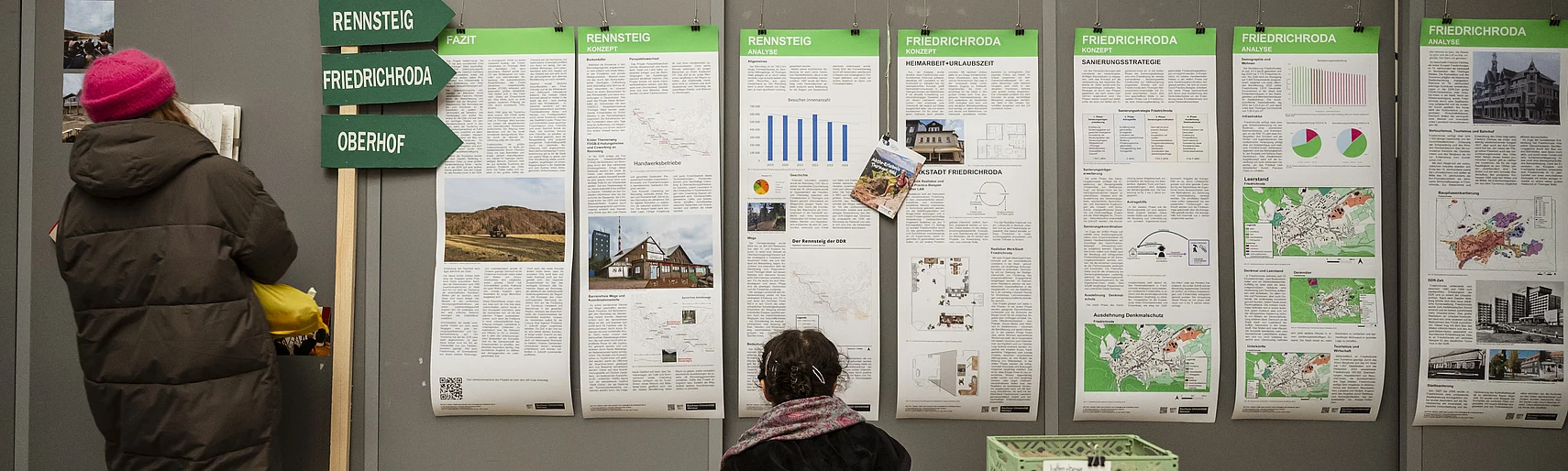
Understanding the city. Exploring spaces. Shaping the future.
On the Master’s programme in Urban Studies, you will deepen your academic engagement with cities, space and spatial development. The programme centres on research: you will investigate how spaces emerge and are shaped by social, political, cultural and economic processes.
In doing so, you will combine urban planning and functional issues with social and political perspectives. This will enable you to develop a multifaceted understanding of urban spaces, whilst learning to analyse their changes academically and monitor them critically.

Research, planning, design – for cities and the built environment
The MSc in Urban Planning has a twofold aim: on the one hand, it imparts academic knowledge and research methods that enable young professionals to pursue a PhD. Furthermore, it equips young professionals who will be working in the demanding field of planning and who wish to shape cities, landscapes and regions independently and to a high standard – whether in a planning consultancy, in public administration, at a university or in research institutions specialising in urban and spatial research and planning sciences.
The M.Sc. in Urban Studies benefits from the high level of research activity within the participating departments. For instance, the latest findings from the early-career research group ‘Social Housing Provision in Growing Urban Regions: Urban Planning and Legal Perspectives’, the DFG Research Training Group ‘Identity and Heritage’ or the Marie Curie research project ‘History of European Urban Planning in the 20th Century’ are incorporated into the teaching.
The programme is aimed at graduates with a Bachelor’s, Diplom or similar degree in the field of spatial planning – primarily urban studies, urban planning and regional planning – as well as other spatial-related degree programmes, such as geography and architecture. The programme is academically oriented and taught in German. It is based at the Institute for European Urban Studies. The courses on offer cover the following subject areas:
- Urban planning
- Spatial planning and spatial research
- Social science urban research
- Heritage conservation and architectural history
- Urban development
- Architectural Theory
- Landscape Architecture and Planning
Course structure
The standard duration of the consecutive Master’s programme in Urban Studies is two (as a rule) or four semesters, commencing in the winter semester. Students earn 30 credit points in each semester, starting in the winter semester.
Applicants with a Bachelor’s degree comprising fewer than 240 credit points may, via conditional admission subject to specific academic requirements, make up the missing credit points at the Faculty of Architecture and Urban Studies.
The academic and examination requirements to be fulfilled are set out in the study programme schedule and in the catalogue of credits within the Study and Examination Regulations for the Master’s programme in Urban Studies.
Compensation for disadvantages
The Bauhaus-Universität Weimar takes into account the specific needs of people with health impairments, mental health conditions or chronic illnesses right from the application stage for a degree programme. These conditions include, for example, ADHD, mobility impairments, chronic physical illnesses (e.g. Crohn’s disease), dyslexia, mental health conditions, or visual, hearing and speech impairments.
Prospective students with disabilities have the option of applying for reasonable adjustments for the aptitude assessment procedure. Reasonable adjustments do not mean that applicants receive an advantage over other prospective students, but rather that they create conditions which compensate for the disadvantages faced by those with disabilities.
If you wish to apply for adjustments to the assessment procedure, please note the following: Applications for adjustments to the assessment procedure must be submitted by 22 June at the latest. You must provide credible evidence of your disability; this usually requires a medical certificate or, in justified individual cases, a certificate from a public health officer. You may suggest a specific form of adjustment for the aptitude assessment procedure. Please submit your application for reasonable accommodation in writing; you will be notified of the decision in writing.
Further information on adjustments can be found on the Bauhaus-Universität Weimar website: Support services for students. Any questions regarding adjustments will be answered by the academic advisory service or the representative for students with chronic illnesses and disabilities.
The application for reasonable accommodation must be sent by post by 22 June at the latest to:
Bauhaus-Universität Weimar
Faculty of Architecture and Urban Planning
Institute for European Urban Studies
D-99421 Weimar (Germany)
Master’s theses
The Master’s thesis is the examination paper that concludes the academic programme. It is intended to demonstrate that the candidate is capable of independently addressing a problem in the field of urban planning using academic methods within a three-month period (see Section 9(6) of the Examination Regulations). The most important information on writing the Master’s thesis is summarised in a guide.
Prerequisites
Admission to the Master’s programme requires an above-average B.Sc. degree in Urban Studies, or a higher education qualification recognised by the relevant examination board as being comparable in content, or a qualification from a state or state-recognised vocational academy. As a general rule, applicants should have successfully completed 240 credit points (LP). Applicants with a Bachelor’s degree comprising fewer credit points than the Bachelor’s programme in Urban Studies at the Bauhaus-Universität Weimar may nevertheless be enrolled on the Master’s programme on a conditional basis, subject to specific academic requirements.
Depending on the nature of the missing credits, these may be made up. For example, in the case of a Bachelor’s degree comprising 180 credits, 60 credits must be made up during the Master’s programme. The Examination Board may also recognise skills acquired outside higher education (practical experience) as equivalent to missing credits. Admission is further subject to the successful completion of the entrance examination for the Urban Studies programme. The relevant examination board may also recognise programmes at other higher education institutions with comparable content as equivalents. Further details are set out in the regulations governing the aptitude test for the Urban Studies programme (see Appendix 1 of the study regulations).
Language skills during your degree course
The language of instruction on the Master’s programme in Urban Studies is German. Applicants who are classified as international students and do not have German as their first language must therefore provide evidence of their German language proficiency (DSH-1, TestDaF with at least 4 x TDN 3 or an equivalent qualification), unless they hold a higher education qualification from a German-speaking degree programme. Applicants should also have a command of English sufficient to enable them to understand and reproduce texts of a standard level of difficulty in that language.
Application deadlines
The application period runs from 1 April to 15 July of each year
Any outstanding academic records will not prevent you from applying.
Please apply as early as possible, as you will only receive an invitation to the aptitude interview once your application has been received
Aptitude interviews
The aptitude interviews for the Master’s in Urban Studies will begin on 15 July at the Institute for European Urban Studies, Belvederer Allee 5.
How do I apply for admission to the Bachelor of Science in Urban Planning
If you are interested in fundamental issues of Urban Planning and wish to acquire expertise in the public management of urban development and developing new formats and practical, innovative urban and spatial planning tools, then you are an ideal candidate for this Bachelor of Science.
Requirements
To gain admission to Bachelor of Science in Urban Planning, candidates must have a general university entrance qualification and past an aptitude assessment test.
Commencement
Students may only enrol in the winter semester.
Application to participate in the aptitude assessment test
Please submit all required application materials by post to:
Bauhaus-Universität Weimar
Dekanat Architektur
- Bachelor Urbanistik -
D-99421 Weimar
(Germany)
Submissions by fax or e-mail are not accepted.
Aptitude assessment test
To apply for participation in the aptitude assessment test, please submit the following documents:
- Letter of application (no form necessary)
- Completed and signed online application form (submissions are now being accepted)
- CV in tabular form
- Letter of motivation, max. one page (DIN A4), describing your academic and professional goals
- Certified copy of your university entrance qualification (translated in German)
- Details regarding your prior education, particularly any preparations you have made for university study (in list form with certificates/references if possible; no portfolios please!)
- For international applicants: Proof of language proficiency for university study in Germany (DSH-2)
In the event of unsuitability, the documents submitted will be returned to the applicant after expiry of the objection period upon request and at the applicant's own expense. Please enclose a stamped envelope with the application.
Your physical presence at the Faculty of Architecture is required in order to participate in the tests and interview.
Application deadline
The application deadline for participation in the next aptitude assessment test is 15 July which means the Bauhaus-Universität Weimar must receive all your documents by 15 July, 4pm, at the latest.
The aptitude assessments are carried out in Weimar. Invitations to interviews are sent to the candidates in advance.
Enrolment
Students may only enrol in the Bachelor of Science in Urban Planning after passing the aptitude assessment test. The assessment results are sent to the candidates shortly after they complete the second part of the test.
The enrolment period ends on 30 September. For more information about enrolment procedures, click h.ere
The assessments are valid for two academic years, i.e. the academic year for which the candidate has applied for enrolment and the year thereafter.
If you have further questions, don’t hesitate to contact our faculty advisors.
Aptitude test
Once we have received your complete application documents, a selection interview will take place in mid-July; you will be invited to this in good time. For applicants living abroad or for whom travelling to the initial interview is not always reasonable or feasible, the selection board may arrange an alternative date or make alternative arrangements to assess their suitability.
Enrolment
Enrolment on the Master’s programme in Urban Studies can only take place once the aptitude assessment has been successfully completed. Notifications of the results of the aptitude assessment will be sent out shortly after the aptitude interview.
The enrolment deadline is 30 September.
If you have successfully passed the aptitude assessment, please send the following documents to the
Department of Studies and Teaching
Bauhaus-Universität Weimar
Department of Studies and Teaching
Geschwister-Scholl-Straße 15
99423 Weimar
• proof of having passed the aptitude test
• proof of valid health insurance, including the relevant registration forms from the health insurance provider
• a copy of the payment receipt for the semester fee
• a certificate of de-registration, if you have previously studied at another higher education institution.
And after you’ve finished your degree?
The Master’s programme in Urban Studies equips its graduates to either take on more demanding roles in urban planning practice or to work in a research- or education-oriented institution. The programme is designed to prepare students for doctoral study.
Specific career prospects lie in the following areas:
- Urban development
- Urban development policy
- Spatial planning
- Education and knowledge transfer
Many paths. One urban profile.
Graduates work in urban and regional planning departments, local authorities and at regional and national levels, as well as in private planning consultancies, companies, non-governmental organisations, research institutions and political consultancy firms. International organisations and institutions involved in European and international urban development also offer career opportunities for urban planners.
Do you have any questions about your degree programme?
Dr. Caroline Kauert
Fachstudienberatung Bachelor und Master Urbanistik
Do you have any questions about the application or the selection process?
Susan Schür
Bewerbung Master Urbanistik