

Profile
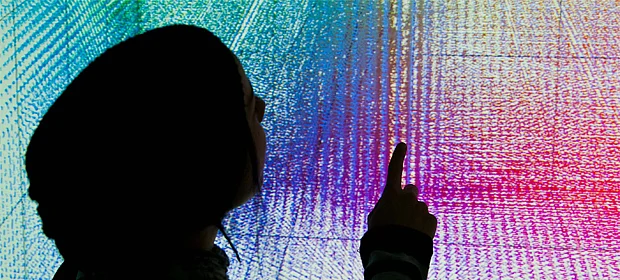
In the English-language Master’s degree programme Computer Science for Digital Media, students are introduced to the latest research findings in the field of interactive digital media. In addition to providing research-oriented professional training, the programme helps students acquire communication and presentation skills through their project work.
You study current topics in media informatics:
- Media security
- Data Mining
- Information Retrieval
- Machine learning
- Visual Analytics
- Optimisation
- mathematical modelling
- Human-Computer Interaction
- Mobile media
- Usability
- Virtual Reality
- Computer graphics
- Computer Vision
- Visualisation
More detailed information on the curriculum can be found at » this page.
Our Professors
The research-oriented Master's programme is supported by internationally renowned professors who have a proven scientific track record and are nationally and internationally committed:
- Prof. Stefan Lucks (Member of the Skein team, finalist in the NIST Cryptographic Hash Algorithm Competition)
- Prof. Benno Stein (Founder of internationalen PAN Competition, specialised in plagiarism detection, authorship and social software abuse)
- Prof. Charles Wüthrich (Close cooperation with an educational TV production company)
- Prof. Bernd Fröhlich (winner of Virtual-Reality Technical Achievement Awards, Co-Founder of theIEEE Symposium on 3D User Interfaces)
- Prof. Volker Rodehorst (recognised expert in the fields of computer vision and photogrammetry)
- Jun.-Prof. Dr. Jan Ehlers (Expert for Usability, Brain-Computer Interfaces, Physiological Computing, Biofeedback and kognitive pupillometrie)
- Prof. Eva Hornecker (Expert in the fields of innovative human-computer interaction concepts, user-centered design and museum installations; co-founder of the international conference series 'Tangible Embedded and Embodied Interaction'; back in Germany after 8 years in UK and New Zealand)
What we offer you
Current research topics
The internationally research-strong professorships provide you with in-depth theoretical foundations complemented by highly topical research questions and results. Our students are regularly involved in research and development projects as part of their project work and theses, and as student assistants.
Key qualifications relevant to the profession
The Weimar project studies offer you a framework to propose, realise and defend your first independent research developments. In doing so, you will learn to work independently, team-oriented and solution-oriented.
Excellent labs
In our 2016 graduate survey, respondents rated access to computing services, availability of lab space and teaching and learning spaces, and lab space facilities as above average compared to other computer science degree programmes.
These laboratories are available to you during your studies:
- Electrical Engineering Lab (Lectureship in Networked Media)
- Virtual Reality Lab (Chair of Virtual Reality Systems)
- Networked Media Lab (Lectureship in Networked Media)
- Compvis Lab (Chair of Computer Vision in Engineering)
- Web Technology Lab (Chair of Content Management and Web Technologies)
- Mobile Media Lab (Chair of Mobile Media)
- Gfx Lab (Chair of Graphic Data Processing)
- Media Security Lab (Chair for Media Security)
- WinuX pool
- LiNT Pool
For research and final theses, the following state-of-the-art laboratories are also available in the Digital Bauhaus Lab on approx. 300 m2:
- User Interface Development Lab
- Human-Computer Interaction Lab
- Computer Vision Lab
- Computer Graphics Lab
- Virtual Reality Lab
- Multi-User 3D Display
- Visual Analytics Display
Very good supervision ratio
The chairs are staffed with two or three doctoral students by the faculty and in most cases have other project-funded staff who also supervise projects and theses. This results in an excellent supervision ratio with approx. 30 first-year students per year and over 30 staff members as well as 8 professors, which leads to direct and intensive contact between teachers and students.
Research orientation and student publication activity
Two further indications of the research orientation of the degree programme are the student publications and the activities after graduation in the academic or research-related environment: In the student research projects and from the final theses of the Master's programme, publications are often already produced at national and international conferences, in which our students are significantly involved. In addition, a significant proportion of the graduates of recent years go on to do doctorates at professorships in Weimar and at other universities in Germany and abroad.