

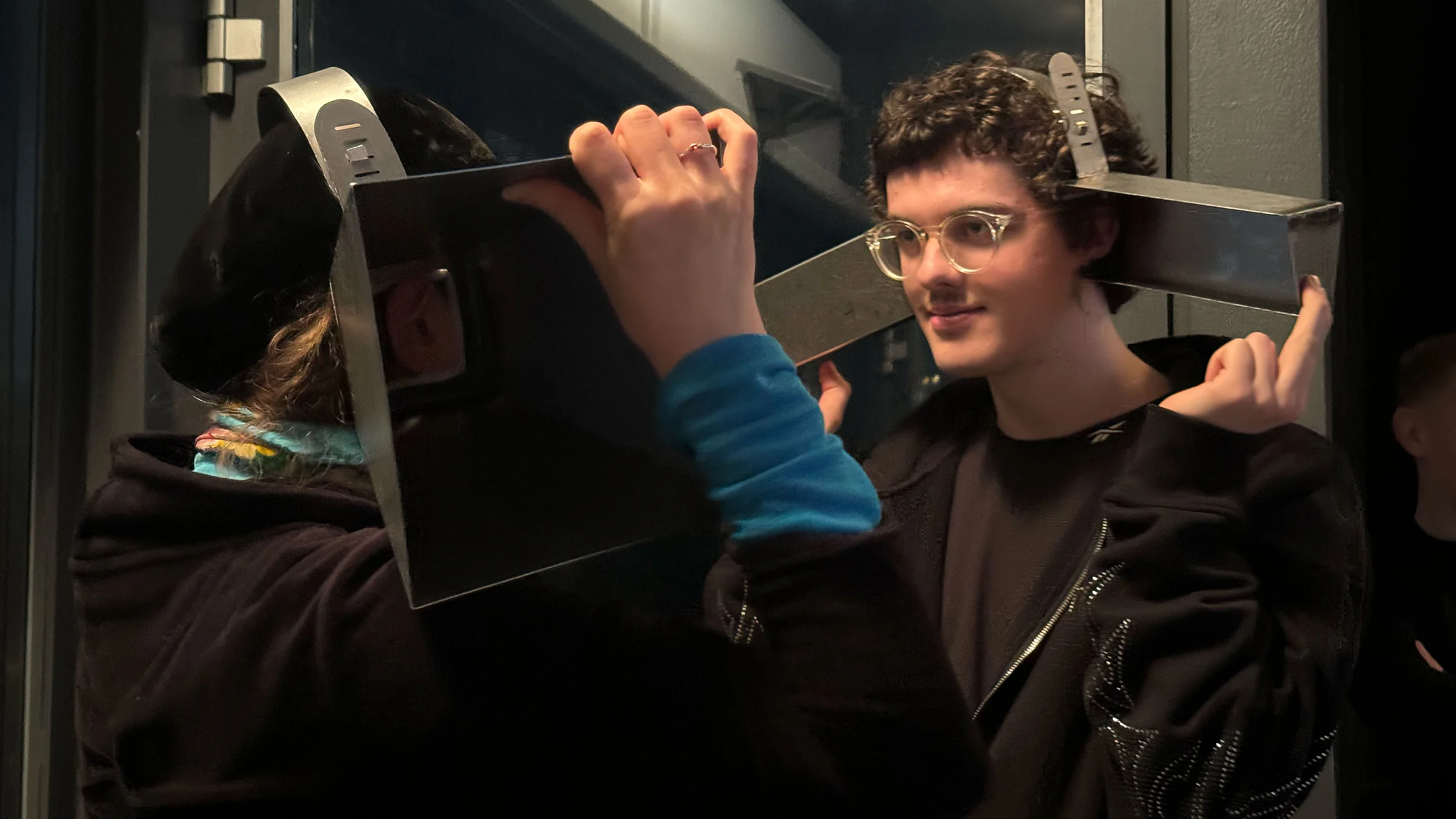
In our teaching, we engage with sound as a central medium for exploring ecological, social, technological and cultural webs of relations.
We start from the recognition that no form of life – and none of our human practices – can be understood apart from its embeddedness in the relational webs of its environment(s), whether artistic, design-based, scientific or humanistic, academic or non-academic. What can happen, and what can emerge, when we begin to think everything consistently in terms of mutual connection, and put "ecological thinking" to the test in practice?
We understand our own and other bodies both as instruments and as resonating spaces of perception, extended and reflexively questioned through technologies. Methodologically, our teaching combines experimental, practice-based approaches with theoretical analysis and places strong emphasis on research-led, experience-based learning.
→ Selected student projects from Acoustic Ecologies and Sound Studies
Community of Dissent
Community of Dissent
Community of Dissent
Project module · 6 SWS · 18 ECTS · Taught by: Jun.-Prof. Kerstin Ergenzinger, Dr. Marcin Pietruszewski
Plenary: Tuesdays, 13:30–16:45, from 13 October 2026 · Marienstraße 5, Project Room 203
Sonic Tuesdays / Sonic Talks: Tuesdays, 19:00–21:00
Individual consultations (online): Thursdays 14:00–17:15 and Fridays 09:00–10:30
Language: German and English (bilingual) · BISON no. 326220017
We live together, and we do not agree. This "we" is not only human. It names the shared, adjacent and seemingly separate environments and communities in which more-than-human forms of life and we act upon one another. Even apparently parallel, distant or separate states are permeable: interventions, influences and long-distance connections take effect without their material and temporal chains necessarily being known or conscious.
In this project we ask what connection means under conditions of disagreement. We treat and negotiate the connections of a web of relations as medium and working material in their own right. What makes me a member of a group when I play, and what when I listen?
Feedback and interaction are used not as metaphor but as method: a system of nodes that feed one another without having to agree. We work with contradiction and dissonance, with borrowing, lending and stealing from shared material, with coexistence, arriving and leaving.
Over the semester we develop a collaborative, sculptural sound installation for the joint exhibition of the sound area at the Winterwerkschau. The planned venue is the Sendehalle.
We work with networked and distributed sound systems, sculptural and kinetic elements, acoustic and electroacoustic coupling, transducers (microphones, exciters) and field recording. The means develop out of what participants bring into the project. Previous experience is welcome but not required, and non-sounding contributions are explicitly part of the concept.
Readings and discursive references for a critical contextualisation of community, civilisation and ecology range from Charles Darwin, Ernst Haeckel and Lynn Margulis through Gregory Bateson, Heinz von Foerster and second-order cybernetics to John Bishoff, James Bridle, David Graeber and David Wengrow, David Haskell, Timothy Morton, You Nakai, John Oswald, Curtis Roads, as well as Margo Neale and Lynne Kelly. Historical and artistic references include Maryanne Amacher, Lygia Clark, Gego, Gordon Pask, Sara Szee, David Tudor, The League of Automatic Music Composers and The Hub, among others.
The project is built on collaboration. We work in plenary sessions, in groups and in one-to-one conversations; contributions emerge in teams and take shape through exchange. Work carried over from previous projects is also welcome and can find its place in the shared assemblage.
Format: The course takes place as regular meetings – plenary sessions, input lectures and exercises, partly in block format. Projects and semester assignments are additionally supported through individual consultations. The semester schedule and dates will be discussed at the first meeting.
Assessment: Collaborative, sculptural sound installation for the joint exhibition of the sound area at the Winterwerkschau. Regular attendance, completion of assignments and active participation in the seminar are expected.
Target group: Interested students from other degree programmes of the Faculty of Art and Design, from other faculties and from the HfM are welcome. If there are too many applicants, places are allocated by priority, degree programme and letter of motivation.
Signal and Trace
Signal and Trace
Signal and Trace
SIGNAL AND TRACE: Electronic and Electroacoustic Music, Sound Art, and Their Archives
Academic module (Wissenschaftsmodul) · 2 SWS · 6 ECTS · Taught by: Dr. Marcin Pietruszewski
Mondays, 17:15–20:30, from 19 October 2026 · Steubenstraße 8, Haus A, Project Room 601
Language: English · BISON no. 326230005
Every electronic sound arrives through a machine, and every machine carries assumptions about what listening is for. This seminar takes those assumptions as its subject. We work across a century of electronic and electroacoustic music, tape composition, computer synthesis, sound art and current practice, but not as a chronology. Instead we proceed by mediation: each session sets a contemporary work against an older one and asks what technical, institutional or perceptual conditions connect them.
The method runs in both directions. A piece made this year is read back into the studio conditions, listening habits and material constraints from which its techniques descend. A work from the 1950s or 1960s is heard forward, as something that continues to operate in equipment, software and habits still in use. Neither direction is a matter of influence. What we are after is the recurrence of problems: the grain of the recorded material, the instrument as an argument about music, the room and the loudspeaker as compositional media, the relation between what is calculated and what is heard.
Archives are central to this. Almost everything we can hear of this history reaches us through a recording, a catalogue, a reissue, a scan, an upload, and each of these is a decision about what survives and in what form. We treat archives not as neutral storage but as instruments in their own right: institutional collections, broadcast holdings, commercial reissue programmes, private tape libraries, and the unofficial archives that circulate online. Reading a work means also reading the conditions under which it has been kept, transferred, described and made audible again.
Sessions run three hours and are built around three activities held in tension: listening, reading, and discussion. We listen at length and more than once. Texts are short, read carefully, and treated as evidence rather than commentary. Discussion is the point at which the two meet.
The seminar supports and feeds into several Project and Fach Modules, in particular Audio Tools I and II, Community of Dissent, and the Sendehalle archive project, and it is intended to give students working in these contexts a historical and critical vocabulary for what they are already doing. It also connects to Sonic Tuesdays, the weekly listening and discussion forum organised collaboratively by the three sound professorships of the Bauhaus-Universität and their students, where several of the works and questions raised here are taken up in a wider setting.
No prior technical training is required. Students who work with sound are encouraged to bring their own material into the seminar; those who do not will still find the questions addressed to them, since the object throughout is not a repertoire but the historically shaped condition of being able to hear at all.
Assessment: Attendance and short written assignment.
Audio Tools I
Audio Tools I
Specialist module (Fachmodul) · 4 SWS · Taught by: Alexandru Salariu
Thursdays, 09:30–12:00, from 15 October 2026 (please check the schedule) · Marienstraße 5, Project Room 203
Language: German or English (decided together) · BISON no. 326210015
Audio Tools I is the introductory course in digital sound. You want to work with sound digitally but have no idea how? Or you already have some experience but would like to round out and refresh your knowledge? Then this is the right place for you.
You will learn everything from the absolute basics of sound and vibration, through the fundamentals of field recording and working digitally with sound in a DAW (digital audio workstation), to finishing a mix and a short introduction to mastering. The goal is to complete your own composition by the end of the course, which we will present at the Winterwerkschau, either as an installation or possibly as part of a radio show. The finished composition and its presentation at the Winterwerkschau form the graded assessment for the course.
Each week there is an input and a practical assignment to be completed by the following session. At the start of each session we listen to the results of the previous assignment – knowledge is acquired through practice, and listening together trains our critical ear. After the course and a lunch break, the Open Klanglabor takes place at 13:00; participants are welcome to stay in the Klanglabor, keep working on their compositions and assignments, and get advice.
Target group: The course is open to all degree programmes; please check your study regulations. Students of Media Art and Design (MKG) and Art Education (Lehramt Kunst) have priority.
Instrumentalities for Acoustic Ecologies (project module)
Instrumentalities for Acoustic Ecologies (project module)
Summer term 2026
Project module · 16 SWS · Lecturers: Assistant Professor Kerstin Ergenzinger, Dr Marcin Pietruszewski
Overview:
What exactly are instruments – and what might they be? What happens when we begin to consistently consider everything in terms of interrelationships and translate ‘ecological thinking’ into sonic practice?
Both courses, entitled “Instrumentalities for Acoustic Ecologies”, explore the mediating tools – perceptual, technological and conceptual – through which we encounter, analyse and intervene in sonic environments.
The project module unfolds a playful process of concrete investigation and creative practice. The academic module develops critical and theoretical frameworks. Both modules feed into one another: practical encounters with instruments, places and materials generate questions that reorient the theoretical discourse. At the same time, critical frameworks open up new possibilities for creative intervention.
We are working towards the joint Summaery Sound exhibition programme.
The courses are designed to complement one another. Students who opt for the project module should also attend the academic module.
Instruments beyond music:
The term ‘instrument’ extends far beyond its conventional musical meaning. An instrument is any device that expands, focuses or transforms perception and action. The ear itself is an instrument: a biological transducer with specific sensitivities, thresholds and blind spots that shape what we can perceive of the acoustic world. Scientific instruments – sound level metres, spectrographs, microphone arrays – further expand and limit this knowledge by making certain phenomena perceptible whilst obscuring others. Even notation systems, field-recording practices and analytical frameworks function as instruments: they are not neutral windows onto sound, but active contributors to the construction of what ‘sound’ becomes for us. Following thinkers such as Don Ihde and Jonathan Sterne, we understand instruments as relational – they do not simply reveal a pre-existing world, but help to bring into being the phenomena they measure.
Acoustic ecology as a discipline and practice:
Acoustic ecology emerged in the 1970s from R. Murray Schaffer’s World Soundscape Project as an interdisciplinary field concerned with the relationship between living beings and their sonic environments. It encompasses analytical work (soundscape studies, bioacoustics, urban sound research), artistic practice (soundscape composition, phonography, sound installation) and activist dimensions (noise abatement policy, sound design, the preservation of endangered soundscapes). Contemporary acoustic ecology has evolved beyond Schaefer’s sometimes nostalgic framework and incorporates postcolonial ways of listening, non-human acoustics and political questions, including whose ears and whose instruments determine the quality of environmental sounds.
Both courses ask: What tools do we need – and which tools must we critically question – in order to listen ecologically?
Learning outcomes:
Practical competence in field-based sonic research, including experimenting, playing and tinkering with material, digital, conceptual and embodied instrumentalities. Developing work that demonstrates both technical skill and critical reflection. Key competences include:
- Advanced recording techniques and experimental use of microphones as instruments
- Analytical listening, reduced listening, incidental listening, semantic listening, listening over both long and short periods of time
- Taking into account the extended acoustic sensorium (not just the ear), but the body as an instrument; working with measurement and visualisation tools: spectral analysis, sound level mapping, spatial documentation
- Formulating artistic research questions that link sound practice with ecological and political issues
Assessment:
An independently developed project in which you use a chosen ‘instrumentality’ – a tool, a technique or a conceptual framework – to investigate a specific acoustic environment and thereby produce a practical outcome, e.g. a composition, an installation or an intervention. Everyone is invited to bring along work they have already started and to develop it further within the framework and context of the project module. Regular attendance and active participation in the seminar are expected.
Additional information:
The course takes the form of regular sessions: plenary sessions, input lectures and practical exercises, as well as, in some cases, blocks of sessions such as workshops or excursions. Individual projects and term assignments are also supported through one-to-one consultations. The exact term schedule and dates will be discussed at the first session.
Instrumentalities for Acoustic Ecologies (Research Module)
Instrumentalities for Acoustic Ecologies (Research Module)
Summer Semester 2026
Academic module · 4 SWS · Lecturer: Dr Marcin Pietruszewski
Overview
What exactly are instruments – and what might they be? What happens when we begin to think of everything in terms of interrelationships and translate ‘ecological thinking’ into sonic practice?
Both courses, entitled “Instrumentalities for Acoustic Ecologies”, explore the mediating tools – perceptual, technological and conceptual – through which we encounter, analyse and intervene in sonic environments.
The academic module develops critical and theoretical frameworks. The project module unfolds a playful process of concrete investigation and creative practice. Both modules feed into one another: practical encounters with instruments, places and materials generate questions that reorient the theoretical discourse. At the same time, critical conceptual frameworks open up new possibilities for creative intervention. Together, we work towards the joint ‘Summary Sound’ exhibition programme.
The courses are designed to complement one another. However, students may also choose to attend only the academic module.
Instruments beyond music
The term ‘instrument’ extends far beyond its conventional musical meaning. An instrument is any device that expands, focuses or transforms perception and action. The ear itself is an instrument: a biological transducer with specific sensitivities, thresholds and blind spots that shape what we can perceive of the acoustic world. Scientific instruments – sound level metres, spectrographs, microphone arrays – further expand and limit this knowledge by making certain phenomena perceptible whilst obscuring others. Even notation systems, field-recording practices and analytical frameworks function as instruments: they are not neutral windows onto sound, but active contributors to the construction of what ‘sound’ becomes for us. Following thinkers such as Don Ihde and Jonathan Sterne, we understand instruments as relational – they do not simply reveal a pre-existing world, but help to bring into being the phenomena they measure.
Acoustic Ecology as a Discipline and Practice
Acoustic ecology emerged in the 1970s from R. Murray Schaffer’s World Soundscape Project as an interdisciplinary field concerned with the relationship between living beings and their sonic environments. It encompasses analytical work (soundscape studies, bioacoustics, urban sound research), artistic practice (soundscape composition, phonography, sound installation) and activist dimensions (noise abatement policy, sound design, the preservation of endangered soundscapes). Contemporary acoustic ecology has evolved beyond Schaefer’s sometimes nostalgic framework and incorporates postcolonial ways of listening, non-human acoustics and political questions, including whose ears and whose instruments determine the quality of environmental sounds.
Both courses ask: What instruments do we need – and which instruments must we critically question – in order to listen ecologically?
This seminar-based module develops critical and historical conceptual frameworks for understanding the relationship between hearing, instrumentation and the environment. Drawing on sound studies, phenomenology of technology and critical ecology, we examine how instruments – understood in the broadest sense – mediate between listening subjects and soundscapes.
Learning outcomes: Developing a critical vocabulary to discuss the relationships between listening subjects, mediating technologies and sonic environments. Learning to situate perceptual and creative practices within the broader contexts of the history of acoustics, environmental thought and Sound Studies. Key competences include:
Analysing how instruments (from the ear to the algorithm) shape what can be heard, measured and known; understanding the intellectual genealogy of acoustic ecology – from Schafer through Truax and Westerkamp to contemporary critiques; engaging with concepts such as soundscape, acoustic community, schizophony and the positionality of hearing; a critical assessment of the political dimensions of sound measurement standards, noise protection regulations and concepts of ‘sound quality’; reading across disciplinary boundaries: acoustics, media theory, ecology, and the anthropology of the senses
Assessment
: Production of written pieces demonstrating a theoretical engagement with the course topics. These texts will contribute to a publication accompanying the joint Summaery-Sound exhibition programme, placing the practical works presented in the project module within a critical and historical context. Possible formats include essays or shorter catalogue texts.
Audio Tools I
Audio Tools I
Summer Semester 2026
Specialist module · 4 SWS · Lecturer: Jason Langheim
Sound shapes spaces – visible and invisible, real and imagined. The Audio Tools I course focuses on creative work with fixed-media pieces and the sonic exploration of spaces. How can a place be made tangible through sound? What atmospheres are created through editing, effects and spatial design?
The Audio Tools course offers a practical introduction to the production of fixed-media pieces in a professional sound and radio studio. The focus is on the creative and technical work with pre-produced sound material – from recording and editing through to the final mix. Thematically, the module explores the design, perception and staging of acoustic and artistic spaces.
Students will gain a basic understanding of signal flow in the studio, the targeted use of equalisers and dynamic effects, and how to use common editing and production software (e.g. Reaper) with confidence. In addition, mobile recording techniques are explored to tap into different sound sources for students’ own compositional work.
Successful completion of the ‘Audio Tools’ module qualifies students to use the Experimental Radio studios independently and enables them to produce their own audio works. Regular active participation and involvement in the final broadcast at the end of the semester are
prerequisites for successful completion.
Audiotools II – STOMATA / Receptors & Emitters
Audiotools II – STOMATA / Receptors & Emitters
Summer Semester 2026
Specialist module · 4 SWS · Lecturer: Alexandru Salariu
This seminar offers an introduction to 1. Receptors: advanced and unusual microphone, field recording and post-processing technologies; and 2. Emitters: advanced sound reproduction technology. The course expands your sound output capabilities and your perception of sound environments beyond human perception. It is a practice-oriented course with time set aside for working with the equipment, including two outdoor field-recording excursions.
Stoma (pl. stomata) is a Greek word meaning ‘mouth’ or ‘opening’. In botany, it is used to describe a pore that exchanges gases with the outside world, and it serves as a metaphor for our electronic audio technologies, helping to broaden our understanding of sound reception and emission.
You will learn how to use contact microphones, geophones, hydrophones, directional microphones, electromagnetic microphones and ultrasonic microphones to record airborne and structure-borne sound in the elements (air, water, earth) across a range from subsonic to ultrasonic frequencies and electromagnetic waves. We will then learn how to edit the recordings and explore various options for sound output, ranging from conventional loudspeakers to directional arrays, structure-borne sound transducers and vibration motors.
By taking part in each chapter of the seminar, you will be able to borrow the specific equipment from the sound hire service.
Tiefenzeit (Deep Time)
Tiefenzeit (Deep Time)
Winter Semester 2025/26
Project module · 16 SWS · Lecturers: Jun.-Prof. Kerstin Ergenzinger, Dr Marcin Pietruszewski, Florencia Curci
Introduction The ground beneath our feet is neither immobile nor still. Tectonic plates have been drifting for millennia, sediments accumulate as archives of pressure and fractures, rivers vanish into underground channels, and the planet itself rotates ceaselessly on its axis. These movements, largely imperceptible in everyday human life, are the conditions of all existence. They form the rhythms of geological, planetary and cyclical deep time, which quietly organise our orientation in the world.
In this module, we approach deep time through three interwoven perspectives. Firstly, soil-earth: the material depth of soils, sediments and infrastructures, and at the same time the embodied act of grounding ourselves, of anchoring ourselves within them. The soil appears as a geological archive layered with stories of exploitation, erosion and resistance, whilst grounding appears as a practice of contact and presence within that which sustains us. Secondly, flows: the subtle and profound bonds that hold things together, from underground rivers connecting distant bodies of water to the threads of mycelium weaving nutrients across vast networks, or more abstract currents of memory and relationship circulating beneath our perception. Thirdly, rotations: the cyclical movements that never return as the same thing—the planet’s rotation through day and night, the spiral-like repetition of the seasons, the expansion and contraction of the breath. Every cycle is both repetition and difference, a movement of return that transforms. These three perspectives interweave to form a shared question that unfolds in several directions: How can artistic practice resonate with temporalities that extend beyond human perception?
Method
The focus of this module is on methods and methodologies – on ways to sense, trace and amplify what deep time does to us. Drawing is understood not as representation, but as a form of thinking, as a way of tracing lines and movements as they unfold over time, drawing on Tim Ingold’s thesis that the line is a living gesture. The construction and playing of instruments are explored as a practice of creating new instrumentalities – both tools and embodiments that not only capture but actively shape relationships with soils, currents and rotations. Readings (Ingold, Careri, Lefebvre and others) accompany these practices as companions and provoke connections between embodied experiments and theoretical reflection.
Outcomes
By the end of the semester, participants will have compiled a collection of traces: drawings, recordings, instrument prototypes and essays in various forms – written, oral, audio and performative. These outcomes are not regarded as finished works, but as fragments of research that record encounters with deep time.
Each student will write an essay for their credits, the form of which is open to them. The semester concludes with a joint session in which these essays are read aloud, recited or performed to one another, thereby creating a shared resonance of the investigations.
Further information
Teaching on the project module will take place in collaboration with the curator, radio and sound artist Florencia Curci https://www.florenciacurci.xyz/ and with Marcin Pietruszewski, with a particular focus on the relationship between image and sound.
Sound and Image
Sound and Image
Winter Semester 2025/26
Specialist module · 6 SWS · Lecturer: Dr Marcin Pietruszewski
The Sound and Image module explores the dynamic interplay between scientific imaging and sound through data sonification using the SuperCollider programming environment. Students learn the basics of SuperCollider and develop the skills to transform visual data into sound and to experiment with various sonification methods. A key focus is on the exploration of multi-channel sound, through which immersive acoustic experiences are created that expand the spatial and conceptual dimensions of sonification.
Beyond technical skills, the module encourages a critical engagement with the cultural, theoretical and ethical aspects of digital image and sound media. Students analyse the formats, structures and implications of digital images, scrutinise their role in contemporary culture and reflect on the impact of digitalisation on perception. Discussions also address sound as a vehicle for knowledge and the question of how auditory representations can convey complex scientific and cultural narratives.
The module facilitates a wide range of creative and intellectual outcomes. Final projects may include programme-based multi-channel sonification designs, experimental sound compositions or critical essays on the relationship between sound, image and knowledge. By integrating technical, creative and critical approaches, the module fosters interdisciplinary thinking and innovative explorations of sound and image.
Wetlands
Wetlands
Winter Semester 2025/26
Specialist module · 4 SWS · Lecturers: Jun.-Prof. Kerstin Ergenzinger, Professor Ursula Damm, Mindaugas Gapsevicius
Additional teaching staff:
Prof. Kerstin Ergenzinger, Bauhaus University Weimar
; Prof. Ursula Damm, Bauhaus University Weimar;
Dr Mindaugas Gapsevicius, Bauhaus University Weimar
; Prof. Angeliki Poulou, National and Kapodistrian University of Athens
; Prof. Laura Beloff, Aalto University
Prof. Dimitris Charitos, National and Kapodistrian University of Athens
Prof. Alexandros Kontogeorgakopoulos, National and Kapodistrian University of Athens
Prof. Katerina Antonopoulou, National and Kapodistrian University of Athens
Prof. Haris Rizopoulos, National and Kapodistrian University of Athens
The course explores the intersection of art, science and ecology through interdisciplinary research and artistic practice. Focusing on aquatic ecosystems, participants will develop artistic projects and embodied sensory experiences. Fieldwork will take place in Psachna, Greece, with particular attention to the Kolovrechtis Wetland and the Chalcis Strait.
Students will engage with a variety of artistic and research methodologies – including storytelling, creative writing, interactive installations, and scientific approaches. The course fosters both experimental and reflective modes of knowledge production, supporting dialogue between disciplines and encouraging the development of new collaborations across ecology, digital media, and contemporary art.
Through embodied research, we will explore the ecological, generative and disruptive dimensions of sensory perceptions – listening, seeing, smelling, tasting, touching and beyond. Participants will be invited to:
1) Develop curatorial, dramaturgical or theoretical perspectives on aquatic environments;
2) Create interactive installations as tools for artistic inquiry and as platforms to reimagine ecological interdependencies beyond human-centred perspectives;
3) Critically examine technology, its entanglements with ecology, and its role in the climate crisis.
During the fieldwork, students are expected to develop a small project, a prototype, or a component of a larger project. Emphasis will be placed on group discussions, informed by lectures and supervision. Each participant (individually or in groups) will present their project at the end of the week and document it on a shared wiki platform.
The course is coordinated by the Acoustic Ecologies and Media Environments departments at Bauhaus University Weimar, hosted by DCARTS at the National and Kapodistrian University of Athens, with the participation of the Department of Art and Media at Aalto University. It is offered within the framework of the Erasmus Blended Intensive Programme and carries 6 ECTS credits.
AÖ & EKK – Absolute Beginners
AÖ & EKK – Absolute Beginners
Winter Semester 2025/26
Specialist module · 4 SWS · Lecturers: Jun.-Prof. Kerstin Ergenzinger, Maximilian Marcoll, Hans-Martin Rehnig, Dr Marcin Pietruszewski, Yue Wang
Anyone aiming for a BA (Bachelor’s) must start with AB (Absolute Beginners). In this first semester, you will get to know all the academic staff on the Media Art / Media Design (MKG) programme, which will then help you decide on your personal area of specialisation. The auditory and the visual, the event-driven, the conceptual, the interactive: these areas intertwine, and the possible combinations are diverse.
The compulsory introductory module introduces you to all areas of teaching through experimental micro-projects and design exercises, which will alternate throughout the semester:
Interface Design 20.10.25 – 30.10.25
Design of Media Environments 3 Nov 25 – 14 Nov 25
Media Events 17 November 2025 – 28 November 2025
Experimental Radio 1 December 2025 – 12 December 2025
Acoustic Ecologies and Sound Studies; Electroacoustic Composition and Sound Art 5 January 2026 – 16 January 2026
To complete your first semester, you must successfully complete all five subject modules.
Audio Tools I: Listening → ( ) → Sounding
Audio Tools I: Listening → ( ) → Sounding
Winter Semester 2025/26
Specialist module · 4 SWS · Lecturer: Yue Wang
Listening → ( ) → Sound. How would you complete this title? Recognising, understanding, recording, processing, editing, designing, producing … This introductory course in audio technology systematically imparts a broad range of knowledge that you’ll need to begin your explorations in the field of sound.
The course consists of regular weekly sessions and a two-day workshop:
Through the input and exercises over the first two months, you’ll gain a basic understanding of acoustics, recording and playback techniques, as well as confidence in using common editing and production software (e.g. Reaper, Ableton, Max/MSP and other audio plugins).
The workshop at the end of the semester offers further practical applications. Over these two days, participants will each produce and present a short fixed-media piece or a sound performance.
This course is part of the ‘Acoustic Ecologies and Sound Studies’ programme, in collaboration with ‘Experimental Radio’. Successful completion of this course entitles participants to access our sound library and to work independently in the M5 Sound Lab.
Audio Tools II: Sound Design in Max/MSP and Mixing for Headphones
Audio Tools II: Sound Design in Max/MSP and Mixing for Headphones
Winter Semester 2025/26
Specialist module · 4 SWS · Lecturer: Jason Langheim
This seminar focuses on experimental sound manipulation and audio mixing for listening via headphones. In the first half of the semester, we will use Max/MSP to develop our own tools for editing and transforming sound. By working with granular structures, time-stretching, spectral interventions, playback rate manipulation, modulation, filtering and random processes, we will explore key techniques in digital sound design. The aim is not simply to write code, but to gain a deeper understanding of sonic processes – as a basis for the informed selection and use of professional software environments.
In the second half, the focus shifts from microscopic sound editing to the spatial staging of sound in the headphone environment. We work with techniques of binaural mixing, virtual acoustics, spatial placement, stereo width, movement within the sound field and sonic dramaturgy. A variety of tools and workflows are utilised – ranging from artificial head recordings and Ambisonics decoders to specialised spatial audio plug-ins. The aim is to develop your own headphone-based audio production that is creatively compelling and technically sound.
A basic knowledge of audio editing is a prerequisite. Knowledge of Max/MSP is helpful but not essential.
Rhythmical Zones
Rhythmical Zones
Summer Semester 2025
For the world is moving, everywhere and everything, without exception, is rhythm, inside or outside our bodies, boundaries are permeable, borders transmuted. With every breath we take, we inhale a multitude of particles from the ephemeral atmosphere that surrounds us. The proteins in our cells are constantly in motion due to the thermal movement of atoms and molecules. In addition to this fast and disorganised trembling, slower movements such as the opening and closing of proteins also take place in the cell. This is the foundation of all life forms, non-human and human, which we also organise into a variety of socio-political rhythms. Or let's slow down a little and imagine the haptic visual rhythm of the bark, which is one of the expressions of the life rhythm of the tree. And a few metres underground, its roots may be firmly attached to rocks products of geological rhythms that are constantly changing, but far beyond the scale of human perception.
In this project module we explore rhythm both as a phenomenon and as a carrier capable of moving between different senses, mental modes, ways of thinking and generating meaning. Through the use of extended sonic practices we will continue the fundamental exploration of the fact that no form of life and none of our human practices can be understood without the relational structures of their environment(s). Whether artistic, scientific or humanistic, academic or non-academic. What can happen and emerge when we begin to think consistently in terms of interconnectedness, to apply ecological thinking and to practice rhythmanalysis?
Instructor: Prof. Kerstin Ergenzinger
Re-enchanting the field
Re-enchanting the field
Summer Semester 2025
Oil shales are marine fossils trapped in rocks containing kerogen, which can be converted into crude oil and gas. The north-east of Estonia is extremely rich in oil shale reserves, which attracted the interest of imperial powers and totalitarian regimes throughout the 19th and 20th centuries. The unchecked violence of colonial and capitalist extraction has left behind vast mountains of industrial ash and polluting materials, which are awaiting remediation and disposal. The enduring legacy of toxic waste in open dumps situated next to forests, rivers and unused agricultural land has given rise to its own queer ecologies, which collectively reshape environments in which established boundaries between waste, residue and resources – or regenerative materials – are continually renegotiated, reconfigured and redrawn.
During this five-day workshop, we aim to explore the recurring cycles of decomposition, death and renewal that are shaping the ambivalent landscapes of extractivism in Estonia, making their queer connections and affinities visible and apparent for critical inquiry and future research. ‘Queer’ in this context does not necessarily describe something that already exists. Rather, ‘queer’ ushers in a certain kind of future of intelligibility for beings and collectives that cannot yet be fully explained. Hence, we regard the shale oil waste dumps as post-natural worlds, traversed by imperial and capitalist relations, whose historically specific modes of (chemo/techno)sociality and untapped potentials we seek to understand.
Lecturers:
Prof. Ursula Damm, Prof. Kerstin Ergenzinger, Mindaugas Gapsevicius (Bauhaus University Weimar)
, Prof. Monika Halkort (University of Applied Arts Vienna)
, Prof. Myriel Milicevic (Potsdam University of Applied Sciences)
, Prof. Kärt Ojavee (Estonian Academy of Arts)
Composing Senses – microcomputers, sensors, data and the sound
Composing Senses – microcomputers, sensors, data and the sound
Summer Semester 2025
Bela — a low-latency platform designed for real-time audio and sensor integration—provides the main entry point for this practice-based course. By using Bela to develop interactive systems that translate sensor data into sonic outputs, students will explore how sound can serve as a tool for gathering, transforming, and disrupting knowledge. Throughout the course, we will examine sonification's epistemic and political implications, analyzing how making data audible can reveal hidden dynamics, contest conventional structures of knowing, and spark new insights across scien-tific, artistic, and sociopolitical domains. We will also revisit key works by pioneering sound artists and researchers, exploring how their approa-ches to sonic knowledge production inform and challenge contemporary practices. Through prototyping sensor-based devices and installations, students will learn how real-time sound processes can facilitate critical inquiries into the world around us.
The in-class activities involve a collaboration with the module ‘Aesthetics of Macroworlds’, led by Dr. Alexander König. Additionally, the module can be taken alongside the scientific module Sound and Epistemo-logy, complementing each other through multifaceted engagement with sound as a carrier, transformer, and disruptor of knowledge.
Instructor: Dr. Marcin Pietruszewski
Sound and Epistemology
Sound and Epistemology
Summer Semester 2025
The course ‘Sound and Epistemology’ explores the relationship between sound and knowledge by treating listening as an epistemological tool and understanding sound as a carrier, generator and disruptor of knowledge. Through readings, discussions and practice-based methods such as soundscape analysis, soundwalks, audification and sonification, students examine the role of sound in scientific, artistic and socio-political contexts.
Key Topics:
• Listening as an epistemological device (situated, embodied, forensic and political listening practices).
• Soundscape analysis and soundwalks as countermapping (critical engagement with spatial narratives through listening and recording).
• Sonification and audification (transforming data into sound and critically examining its epistemological significance).
Students produce short essays and sonic works (e.g. recordings, sound maps, sonifications) to explore how sound produces and challenges knowledge. Selected essays and sonic works may be further developed, compiled into a publication, and presented as part of the Summaery.
The course will engage in dialogue with the specialised module “Composing Senses”, where some of the theoretical discussion will be translated into practical sound experiments.
Lecturers: Dr Marcin Pietruszewski, Eleftherios Krysalis
Technical Basics of Audio Production
Technical Basics of Audio Production
Summer Semester 2025
This module is designed for advanced Bachelor’s and Master’s students in the field of sound who already have experience in audio production but want to strengthen or refresh their technical foundations.
Rather than a conventional lecture series, this module is delivered in four intensive two day long block sessions. Each session is hands-on, combining theory with practical application.
From recording to playback – this module covers the technical essentials crucial for professional audio production:
Microphone Techniques – Types, placement, signal flow, and their application in different scenarios
DAW Setup & Workflow – Structuring sessions, working efficiently, and organizing projects effectively
Editing & Montage – Clean cuts, precise arrangements, and professional handling of audio material
Mixing Strategies – Equalization, dynamics processing, effects, and crafting a balanced mix
Playback & Monitoring – Room acoustics, speaker setup, and professional listening strategies
After completing the four block sessions, you will be able to make informed technical decisions, implement professional workflows, and refine your mixes with confidence. This module provides you with the tools to not only be creative but also technically proficient in the world of audio production.
Instructors: Yue Wang, Eleftherios Krysalis, Jason Langheim
Audio Tools II – Medium, Situation and Expanded Senses
Audio Tools II – Medium, Situation and Expanded Senses
Summer Semester 2025
Listening is always situated. Not only the objects we listen to are inseparable from its position, history and materiality, but also our listening selves. Listening is not a divine sense that provides synoptic clarity, but with certain technologies, we could expand our sensing perspectives, on which our understanding about the world is constructed.
In this course, with the focusing on technical expansion through specific microphones (incl. hydrophone, geophone, contact microphone, ambisonic microphone...etc.) and playback systems (stereo, binaural and multi-channel), we listen to different environments via different physical mediums, while the situations of the places and ourselves are reflected by borrowing the methodology of sensory ethnography. Participants will gain further knowledge on field recording, as well as proficiency in common editing and production software (e.g., Reaper, iZotope RX…).
Instructor: Yue Wang
Tripping on Organ-Ologies 2.0 – Towards an ecology of practices
Tripping on Organ-Ologies 2.0 – Towards an ecology of practices
Winter Semester 2024/25
Loosely based upon and continuing the course, in this semester we will focus on the relations between natural and artificial senses and the environment. From the depth of our ears’ hair cells and human receptors to the far-reaching capabilities of animal and technological sensing, our sensory organs and systems form and fashion our Umwelten: the diverse ‘windows’ through which living beings perceive and experience. What happens when we deeply tune into these processes?
Diving into the ecological aspect of sonic practices and the concept of Umwelten means embodying the fathomlessness of entanglements between environments and sensory systems and taking the leap to listen differently with our own bodies. This attempt holds the potential of opening ourselves towards environmental listening and of shedding a different light on body-mind-world connections.
The methods of this inquiry will again be based on spiraling between practice and theory. We will listen together to live and reproduced sound, make sounds and record them, draw, trace and make marks, read and write. Moving seasonally from autumn to winter, we will engage with somatic practices, exploring movement and stillness, outdoors and inside. We will discuss various forms of ecological-artistic practices and analyze their sonic and polysensorial aspects. A rich mix of texts and artistic examples will aid us in defining what these emerging approaches could look and sound like.
Being an exercise in an ecology of practices, the outcome of this course will be an individual project, developing and manifesting a practice aligned with the ideas engaged with during the semester. Individual tutoring is built into the process.
Teaching in the project module will take place together with composer and artist Dr. Bnaya Halperin-Kaddari. Guests during the semester will include vocalist and herbalist Atalya Tirosh, sound artist and scholar Dr. Janina España Keller and experimental electronic artist Víctor Mazón Gardoqui, with whom we will continue to build microphones as instruments to explore our surroundings with extended acoustic sensors.
Instructors: Prof. Kerstin Ergenzinger, Dr. Bnaya Halperin-Kaddari
SuperCollider Audio Programming
SuperCollider Audio Programming
Winter Semester 2024/25
The class introduces fundamental aspects of SuperCollider programming language and audio synthesis server. We will combine learning basic aspects of Object-Oriented programming (syntax, objects, arguments, data structures, inheritance … ) with development of sound synthesis models (frequency modulation, additive synthesis, granular synthesis …). The class will also include introduction to design of graphic interface (GUI), midi interface and algorithmic composition. No prior knowledge of programming is required.
Instructor: Dr. Marcin Pietruszewski
Sound Studies and Sound Theory
Sound Studies and Sound Theory
Winter Semester 2024/25
The Course serves as an introduction to concepts and practices of Sound Studies with an emphasis on fundamental elements of the Sound Theory. The class features a combination of lectures, demonstrations, seminars and collective listening sessions. We will aim at contextualizing and experientially disentangle multiple notions of Sound and Sound Studies as:
- referring to a culturally defined, a historically and locally very specific and transformational concept of sound in general;
- referring to the operations of hearing and listening as performed by the whole body of human creatures in a specific cultural and historical context (and not referring to listening by the ears only)
- referring to the specific concept of hearing and listening by concentrating only on the ears as listening organs (and not referring to the whole body in kinesthetic motion in everyday life as listening organ);
- referring to non-human modes of listening of animals and machines;
- referring to the very specific cultural concept of sound as proposed and disseminated by research and teaching on physical acoustics;
- referring to a set of creative practices mobilizing sound as artistic material.
Instructor: Dr. Marcin Pietruszewski
Shaping Sound – from concept to synthesis
Shaping Sound – from concept to synthesis
Winter Semester 2024/25
From perceiving sound to auditory memory, from aural imagination to concrete concepts, and from sound waves to audio production, a continuous process of epistemic and technical translation has always been involved, a process of sound design.
In this FM, we focus on sound design and audio synthesis. With the tool of verbalisation, notation, sketching, prototyping, we are to develop our own languages to share our sonic ideas and for interdisciplinary communication. And with the visual programming language Pure Data / Max, we will get into basic techniques of audio synthesis such as additive, subtractive, modulation, granular…etc.
Instructor: Yue Wang, Dong Zhou
Per-son-i-fy?
Per-son-i-fy?
Summer Semester 2024
The Projektmodul focuses on sound, art-science practices, the environment and ecology. By interrogating particular objects of science and environmental phenomena, we ask how we coexist and how can we relate to the world around us. Particularly interesting is to investigate what reveals itself through experiences that are directly accessible to our senses and what is in different stages of instrumental mediation, translation, composition, transformation and imagination. What happens when we transfer something from one medium to another or put different media representations concerning each other? What if we try to make something perceivable at the limits and outside the spectrum of our sensorium or address processes that transcend our temporal dimensions?
Ecologies and ecosystems are polysemic, polyrhythmic and polyphon. Different voices coexist and merge, forming a complex whole that is inherently difficult to grasp and understand. The application of technology to measure, detect and analyse this complexity extends and complicates our sensorial being in the world. How many distinct voices or phenomena present at the same time can one follow simultaneously? What correlations between different phenomena can be made perceivable? By engaging with a variety of instrumental and perceptual modes we aim to gain a more nuanced understanding of our environment and in doing so we also want to consider how "we [could] tell ourselves about climate change without falling silent."
The course incorporates microcomputer technology Bela (https://bela.io/) and a variety of sensors. We will focus on multimodal approaches to interactive design and transformation, including data sonification and visualisation. At the same time, we will deal with compositional, choreographic and narrative strategies, including personification and possibilities for extending data perceptualisation through embodying and narrating. Practical outcomes of the course include handling and expanding the Bela microcomputer, incorporating sensors and dealing with different data formats, processing and analysis of data. Support will be given to learn basic SuperCollider or PureData programming to program the Bela. You will also learn how to document the design (circuit diagrams, conceptualising, implementation and testing), approaches to data sonification, sound synthesis and methods of making phenomena perceivable and translating them into physical—material and sensorial—worlds.
The project is part of a teaching collaboration with seminars in music and media studies at the University of Potsdam and includes an excursion to the conference and festival: Klima | Klang | Transformation – Neue Diskurs- und Erfahrungsräume zwischen Musik und Wissenschaft from June 13-16. Initiated and curated by the Kulturlabor Klanglandschaften, the University of Potsdam (Department of Musicology) and the RIFS, Research Institute for Sustainability, Helmholtz Center Potsdam. The aim of the collaboration is both the thematically focused exchange with students from Potsdam and participation in the interdisciplinary dialogue with work-in-progress projects within the framework of the various presentation formats.
Instructors: Prof. Kerstin Ergenzinger, Dr. Marcin Pietruszewski, Yue Wang
Epistemic Media
Epistemic Media
Summer Semester 2024
The text, composition, film, museum installation, and performance are all epistemic media – they consist of vital means of insight and discovery of new experiences and knowledge. In this course, we will be interested less in epistemology (from Greek episteme ‘knowledge’, from epistasthai ‘know, know how to do’) as a synonym for the theory of knowledge but in epistemology as an inquiry into what it is that makes knowledge. Epistemic media consist of forms and practices, which not only communicate knowledge but also generate new knowledge. We will inquire and reflect on historical, technological and societal conditions under which and the means with which, things are made into objects of knowledge. The media—and particularly media for sound reception, transformation and synthesis—are objects of knowledge. They emerge from a process of research, invention and creation within particular historical and technical contexts. They also produce new insights, data and representations of the phenomenal world; for example as instruments for listening, analysis and feature extraction.
Artists dramatize, modulate, amplify and transform the concept but also bring it to the realm of intuition. Artistic practices can play an active function within the overall process of knowledge formation and expand our understanding of the world around us.
In the class we will interrogate different aspects of listening and audio technology, its histories, representation of sound as data, conversion of analog to digital, spectral and temporal domains of sound. The class will take multiple forms, depending on the week we will have a lecture, seminar, demonstration, collective listening session or a combination of all. The class will focus broadly on:
interactions between disciplines and work at the interface between art and science
inquiring the art as an epistemic endeavor
processes of translation and integration of sound into other media (image, light, haptics)
aesthetics of data perceptualisation (visualisation and sonification)
You will learn methods of media archaeology, critical media analysis and fundamental concepts of digital audio.
Instructor: Dr. Marcin Pietruszewski
Sonic Topologies – from Analysis to Speculation
Sonic Topologies – from Analysis to Speculation
Summer Semester 2024
Originally as a mathematical concept, “topology” demonstrates the structure of a continuous deformation of space. In biology, topology is applied to the modelling of biological relationships in the evolution of different organisms; in computer science, it refers to the way in which devices are connected in a network; and in geology, it addresses the logical connections between geographic entities such as rivers, roads, cities and biotopes…
In this creational module, by borrowing the concept of “topology”, we consider the soundscape as our first physical topological space. Within this space, we use audio-technological means such as measuring, recording, and analysing with visualizers to understand the basic acoustic phenomena, exploring how different sound elements are connected to each other. During this process, sound is transformed into analog and digital forms, transmitted through different media, and perceived by us and other living beings, which can also be regarded as some sort of topologie(s).
Based on this fundamental audio and acoustic knowledge, in the second part of this module, we try to modify, to simulate and to speculate the sound of spaces and entities in the digital environment by using mixing and synthesising techniques (with for example DAWs, Pure Data, Max, etc.).
Instructor: Yue Wang
Radio.earth
Radio.earth
Summer Semester 2024
This Fachmodul combines practiced acoustic ecology with experimental radio. radio.earth is a participatory radio art project that addresses the ecological crisis, its impact on our environment, and possibilities for action. Using custom-made, mobile outdoor microphone units, an open group of contributors worldwide enables and shares live audio streams at irregular intervals over hours to days. The microphones broadcast the soundscapes of selected sites and environments, with varying degrees of land use and degradation, from wild nature to agricultural, urban, and industrial zones. Nature is seen here as a cultural construction, closely interwoven with the ideas and problems of the Anthropocene.
In this sense, we want to use our senses as sensors and engage in our own practice. Embedded in a deeper exploration of the topics described above, we will construct mobile microphone units for subsequent active participation in radio.earth . An aspired goal is the construction and operation of a permanent solar-powered station that will stream from a research area of the Greifswalder Moor Center.
A central aspect is the exchange and discussion of what we can experience, grasp, learn and do through repeated, critical listening over time.
In this sense, we want to use our senses as sensors and engage in our own practice. Embedded in an in-depth examination of the topic described above, we will construct two mobile, solar-powered microphone units, which will then actively participate in Radio.Earth as stationary-mobile, permanent transmitting stations. The aim is that one of the solar-powered stations will stream from a protected location in the research area of the Greifswald Moor Center. For the other unit, we are planning to search for and find relevant locations in cooperation with local nature conservation groups in/around Weimar.
Instructor: Udo Noll
Tripping on Organ-Ologies
Tripping on Organ-Ologies
Winter Semester 2023/24
Organology' is a term from biology and musicology alike and denotes the study and exploration of both musical instruments and the structure and function of organs.
In this project module we develop and play - play and develop - develop while playing - and play developing instruments. What are and can instruments actually be? Technologies, practices, means, tools, extensions, sensors and transformers of conceptual and physical kind - musical/artistic, cosmological and scientific - researching and oblivious. Can instrumentalities expand our human perception and scope of action in a way that make our grasp of ‘being-one-part-of-many’ processes and shared habitats grow?
Methodically we move in the broad spectrum of activating and using our own bodies and body parts as instruments, as well as experimenting with fragmentary parts of musical-instruments, instrument principles and materials. Central is also the examination of choreographic and somatic principles. We work theoretically and practically.
The aim is to conceive our own and/or idiosyncratic instruments from the process of mutual analysis and playing, and then start to try them out resp. realize them.
Teaching in the project module will take place together with composer and artist Bnaya Halperin-Kaddari. Another guest in the semester will be the sound artist Katrin Emler (katrinem), who will create a workshop day on bodies as instruments and perception choreographies. Directly after the lecture-free period, an intensive examination and practical introduction to the construction of microphones and advanced sensors as instruments is planned in a block of several days with the experimental, electronic artist Víctor Mazón Gardoqui.
Instructor: Prof. Kerstin Ergenzinger
Navigating Sound Studies
Terra Quotitiana
Terra Quotitiana
Summer Semester 2023
In this seminar, we set off on expeditions into the sound ecologies of our everyday lives. Expeditions have generally been, and continue to be, undertaken into unknown, little-explored, uninhabited or ‘alien’ territories. We will use sound art to explore the unknown, the unnoticed and the unexplored within the seemingly all-too-familiar, and investigate the rituals, margins and interstices of our everyday lives. In doing so, we aim to learn how to identify sound-ecological networks of relationships and to document, map and analyse these across different spectra of perception. The aim is to experimentally test a form of listening that engages all the senses.
In the background, we are engaged with questions concerning the wide-ranging field of ecology. We will explore what artistic research into acoustic ecology might entail and how it might be conducted, as well as the history of expeditions that were historically driven primarily by colonial motives and adhered to extractivist logics.
Methodologically, we will use our perceptive bodies as instruments, both intuitively and analytically. To this end, we will explore strategies and technologies for recording, capturing, sharing and translating our lived experiences and perceived phenomena.
Over the course of the semester, everyone will keep a sound diary. In addition, each participant will identify a segment or
space within their own everyday life that can be explored in terms of the influence of daily recurring and changing events and phenomena. Alongside this, we will regularly undertake practical exercises as a group and explore and discuss current interdisciplinary projects and artistic approaches.
At the end of the semester, students are expected to develop their own piece of work based on these ‘everyday expeditions’, in order to bring their experiences and findings to life and share them, for example in the form of an audio walk or other choreographic or performative interpretations.
On the theoretical side, Henri Lefebvre’s text *Rhythmanalysis, Space, Time and Everyday Life* will be one of the texts guiding us throughout the semester; we will read and discuss excerpts from it together. In addition, where possible, there will be an excursion to the ‘klangstaette, stadtklänge’ project in Braunschweig, which is being designed and curated this year by the sound artists katrinem and Sam Auginger.
Lecturer: Jun.-Prof. Kerstin Ergenzinger