

Ongoing research projects
Image genres and normativity. Social and aesthetic potentials of genres in art
The project »Image genres and normativity« conceives of genres as aesthetic-social institutions that establish normative orders. My approach encompasses both a historical perspective and systematic inquiries. From approximately 1600 to 1900, the system of image genres structured the social space for both the producers and the recipients of the visual arts, shaping their expectations. This cross-epochal project aims to gain a better understanding of the social and aesthetic potential of genres—as well as the consequences of their diminishing relevance within art. Adopting a comparative perspective, the project examines the field of art alongside other cultural domains where genres have played, or continue to play, a significant role. At the same time, it considers how the meaning of genres and the boundaries between them are shifting under digital conditions.
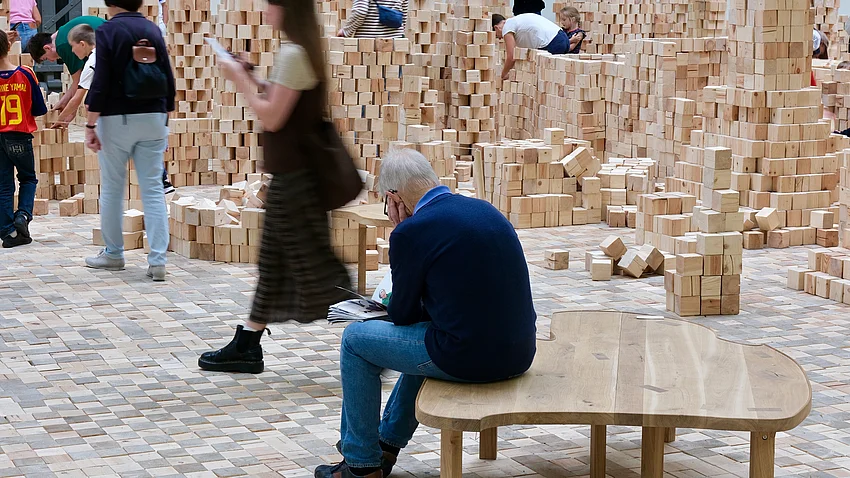
The appeal of contemporary art
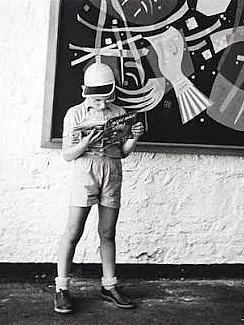
Collaboration with Dr. Léa Kuhn, Central Institute for Art History (Munich)
Although access to art is generally considered difficult and fraught with high barriers, contemporary art attracts enormous interest from a remarkably broad audience. Why is this the case? What do audiences hope to gain from art?
To date, surprisingly little is known about the motivations of today’s audiences. By examining the factors that make art appealing, we view the field not merely as something whose reception depends on one’s social milieu, but as a domain that actively shapes social structures. We aim to incorporate insights from sociology to develop an art-historical perspective on the »appeal of the contemporary.«
›Photology‹. Photographic Measurements of Light in the 19th Century
In the first half of the 19th century, photography served as the primary technology for the study of light. Years before the official unveiling of photography in Paris in 1839, photographic emulsions were being used to investigate the physical and chemical properties of the solar spectrum—one of the most pressing scientific challenges of the era. The ›images‹ produced in this process were a means to an end rather than the end itself; they were not so much viewed as they were analyzed and measured. The discovery of non-visible portions of the spectrum ranks among the most epistemologically significant outcomes of these experiments.
This project explores the close connection between the study of light and the history of photography during the period between 1820 and 1850, with a focus on examining the epistemic status of a new, instrumental type of image.
Events, conferences, workshops
Archeologies of the Communist Avant-Gardes Weimar, June 15 & 16, 2026
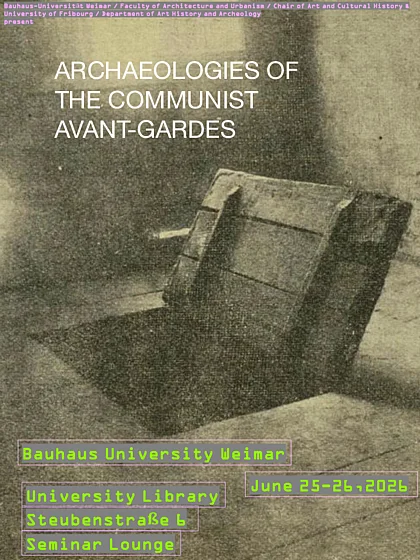
Archeologies of the Communist Avant-Gardes
Ephemerality and Leftist Visual Production in Central and Eastern Europe between the World Wars
Organized by Adrienn Káscor and Tobias Ertl
Weimar, June 15 & 16, 2026
This two-day international conference brings together scholars to grapple with the very absence of objects that could tell us about the aesthetic and political strategies of leftist collective desires from the past. Much of the politically and socially engaged leftist art produced between the World Wars in Central and Eastern Europe has been long “destroyed-disappeared-lost-never were,” to use the provocative theoretical and methodological framework developed by Beate Fricke and Aden Kumler (2022). The majority of communist visual and artistic practices in Central and Eastern Europe were quintessentially ephemeral or have become so. Therefore studying communist and antifascist propaganda, anonymous leftist printmaking, street and festive decoration and agit-prop objects, monuments, Proletkul’t, worker’s photography and worker-correspondence movements, textile and applied arts, and didactic and scientific filmmaking among other aesthetic forms, calls for new and innovative research methods across disciplines.
The conference is organized by the Chair for Art and Cultural History at the Faculty of Architecture and Urbanism at the Bauhaus University, with additional funding from the Alexander von Humboldt Stiftung.
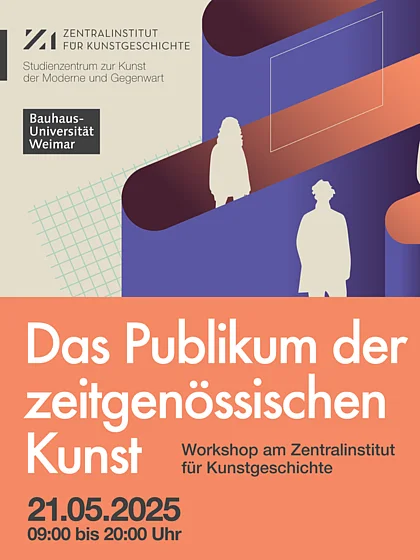
The audience for contemporary art Central Institute for Art History, Munich, May 21, 2025
Digital Genres Authors' Workshop Frankfurt a. M., October 4 & 5, 2024
Genres, Types, and the Avant-gardization of Art Bauhaus-Universität Weimar, December 2023
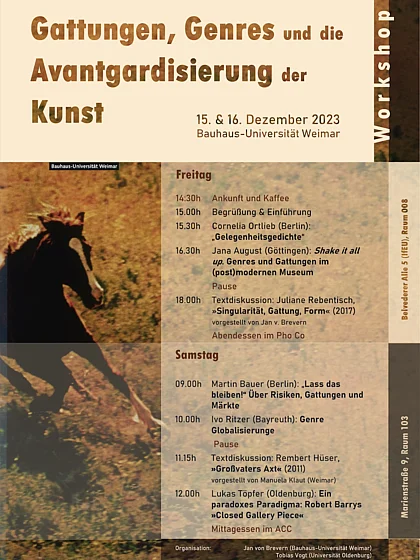
Genres, Types, and the Avant-gardization of Art
Workshop in December 2023, Bauhaus-Universität Weimar
--> Program
Why do we take photographs? University Siegen, summer semester 2022
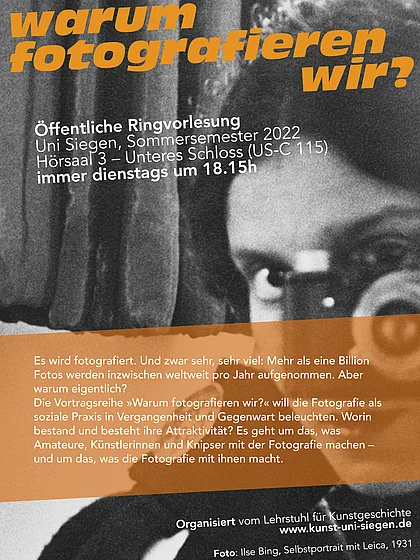
Why do we take photographs?
Lecture series in the summer semester 2022, University Siegen
--> Flyer/Program
Ethics and Aesthetics of Distance (Authors' Workshop) FU Berlin, November 26, 2021
Questions of Style / Histories of Style (Authors' Workshop) Museum of Contemporary Art Siegen, November 15 & 16, 2013

Questions of Style / Histories of Style (Authors' Workshop)
together with Joseph Imorde
Museum of Contemporary Art Siegen, November 15 & 16, 2013
--> Programm
Photography's Past Futures Getty Research Institute, Los Angeles, May 8, 2013

Photography's Past Futures
together with Vanessa Schwartz
Getty Research Institute, Los Angeles, May 8, 2013
--> Program
The Total Recording of the World. On the History of Photographic Measurement Images IFK Wien, May 27, 2011

The Total Recording of the World. On the History of Photographic Measurement Images
together with Katja Müller-Helle
IFK Wien, May 27, 2011
--> Program