The English-language Master's program »Natural Hazards and Risks in Structural Engineering« (NHRE) is a strongly internationally oriented program that trains students who can perform demanding engineering activities under specific external influences, such as earthquakes. We teach modern tools that can be used to assess natural hazards, enable modeling and simulation, and prepare students to perform concrete risk analyses. Thus, the program offers key qualifications to be innovative and pioneering engineers in the fields of various natural hazards such as earthquakes, floods or storms.
The occurrence of an increasing number of natural hazards all over the world and their various effects on individuals, societies and modern economies is one of the major challenges for future decades. The master course in »Natural Hazards and Risks in Structural Engineering« faces this challenge by providing indispensable tools for taking into account those phenomena in the different design processes in civil engineering. Thereby, the master course aims at combining practical structural engineering with state-of-the-art concepts regarding computational mechanics, dynamics and probability theory/stochastic analysis. Consequently, the master course provides key qualifications for innovative work in the field of earthquake, flood and wind engineering and offers an international setting in which students will achieve both technical success and personal advancement.
Structure and contents
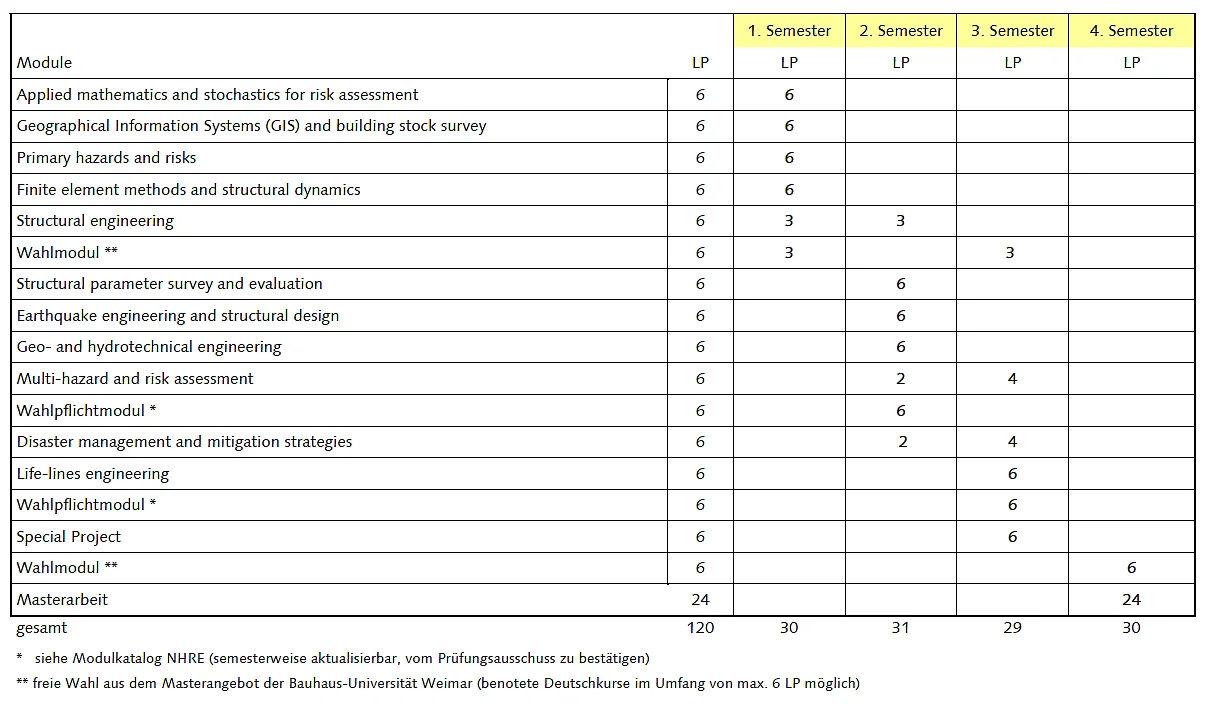
The »Master of Science« in »Natural Hazards and Risks in Structural Engineering« is a four-semester program focusing on earthquake engineering, structural design, geotechnical and hydrotechnical engineering, finite element methods, non-linear analysis under extreme loading, stochastics, risk assessment, and disaster management. The curriculum includes both theoretical and practical topics as well as most recent research results in the field of natural hazard mitigation and structural engineering.
The programme is structured as follows (click to enlarge):
Objectives and goals of the Degree Programme
This intensive, application-based program »Natural Hazards and Risks in Structural Engineering« offers a strong technical foundation in structural engineering, integrating research and practical applications. Students develop advanced oral and written skills, enabling them to tackle complex engineering tasks related to planning, construction, and risk analysis of structures in the context of natural hazards.
The curriculum enhances theoretical and scientific competence while cultivating skills in modelling, simulation, and performance-based design. It explores the interplay between engineering and related disciplines, focusing on structural engineering's role in mitigating natural disaster impacts and assessing structural vulnerabilities.
Additionally, the program emphasizes engineering technology's global and regional demands through international project models. Elective modules prepare students for professional careers or further research opportunities.
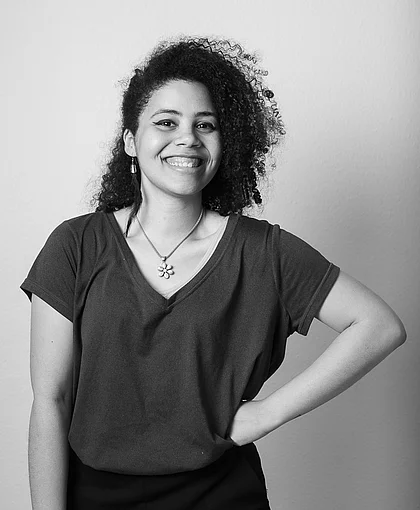
Marjorie Pons
»NHRE allowed me to expand my knowledge in many areas of civil engineering. From learning about different types of structures to natural hazards (and everything in between), I feel that NHRE prepared me in the understanding of both prevention of risks in structures, as well as corrections when damages happen. What I liked the most, though, is that the professors and tutors were very dedicated to teaching us, and I felt supported every step of the way«.
Marjorie Pons
PhD über die Verwendung von alternativen Rohstoffen für Spritzbetonanwendungen an der TU Graz, Österreich

Abdulmagid Bendalla
»The NHRE Master's programme at Bauhaus-Universität Weimar offers a rich selection of study modules, each with its own unique research focus. International students have the benefit of tailoring their education, thanks to the flexibility of the programme and the use of English as the language of instruction. They are also able to learn German alongside their studies. For those seeking a more specialised path, the option to choose from a range of elective modules provides a truly personalised experience. I found this programme to be very beneficial in gaining a comprehensive understanding of structural engineering and discovering diverse career options available in Europe.«
Abdulmagid Bendalla (Alumni 2019)
Job Description and Areas of Application
From experience we know: Graduates of our degree programme enter the professional world quickly and successfully. The demand for well-trained civil engineers is still greater than the supply. Take advantage of the opportunity to prepare yourself for a dynamic and exciting professional world in a Master's degree programme at a small and yet internationally oriented faculty.
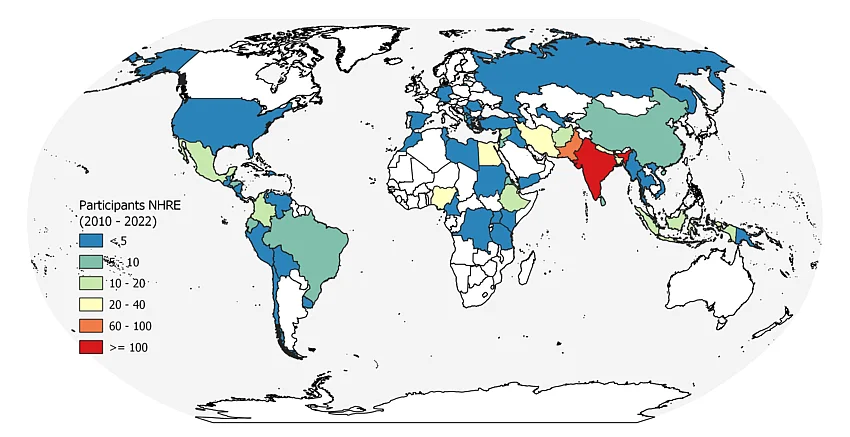
The Master's degree programme NHRE directly addresses the various regions at risk from natural hazards. The target group of students is mainly located in areas that are affected by annually recurring disasters (e.g. tropical storms and floods) as well as by disasters that occur at irregular intervals (e.g. earthquakes and landslides) (South America, Central and Southeast Asia, Africa). Also addressed are employees of authorities with a connection to disaster management, of engineering companies (planning, construction supervision, support) and of research institutions.
The assignment of graduates is inherently oriented towards the professional sector in their target countries, whereby particular emphasis is placed on engineering practice. Networking with local university institutions is desirable, but not mandatory. At the same time, and currently to a particular extent, the European and German labour market is also open to graduates with the appropriate language skills.
What our Alumni say
Astha Poudel
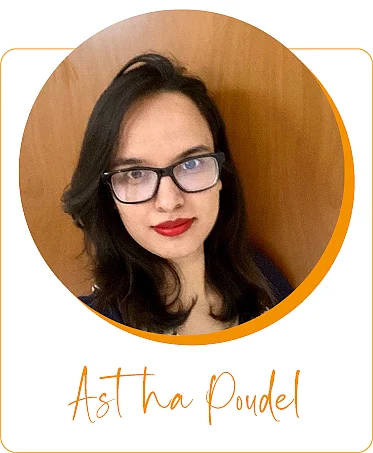
»One of the rewarding aspects of the program for me was the opportunity to work as a tutor for two semesters in the subjects of Geotechnical Engineering and Stochastic and Risk Assessment. This experience gave me a chance to apply the skills and knowledge that I had learned and helped me to further develop my confidence. [...] This experience has been invaluable to my personal growth and has prepared me well for my current pursuit of a PhD jointly at Aristotle University of Thessaloniki, Greece, and Université Grenoble Alpes, France, under the URBASIS Project, funded by the European Commission with an MSCA (Marie Skłodowska-Curie Actions) fellowship.«
Astha Poudel
Marie Curie – ITN Stipendiatin
PhD an Aristoteles-Universität Thessaloniki und Université Grenoble Alpes
Jahrgang 2016 (DAAD Stipendiatin)
Mahfuzul Islam
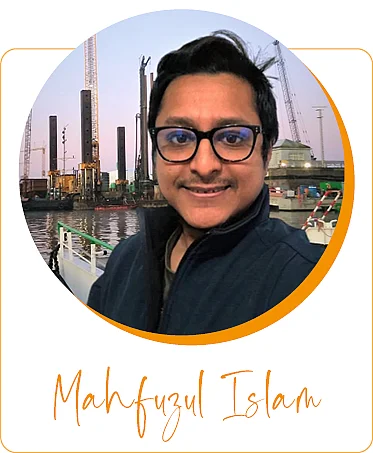
»I liked the structure and the diversity of the NHRE degree programme. The programme was potentially diverse which makes it easier for one to choose a suitable career for oneself. Furthermore, I like that the program includes projects that need computer programming skills. During those project works one gets an extensive experience in different programming skills. I find the experiences gathered in computer programming skills during NHRE program are priceless and help oneself to grow in the further professional environment«.
Mahfuzul Islam
BIM Ingenieur bei Wayss & Freytag Ingenieurbau AG
Bharat Pradhan

»The M.Sc. program NHRE not only expanded my knowledge in core structural engineering, but also in different dimensions of natural hazards like earthquake, wind and flood. The opportunity to learn from the experts in the field of structural engineering, earthquake engineering, structural dynamics, stochastics, and more was truly unique and invaluable. The courses are blended to improve research skills and projects are facilitated to achieve individual goals. The program's structure is very favorable for job opportunities in Germany and further education as it offers networking opportunities with both industry and academia. I am grateful to have had an easy access to a PhD opportunity in Italy due to the international linkages developed during the two years of the master's program.«
Bharat Pradhan
Beratender Bauingenieur, Mitgründer und Vorsitzender von Pro Eth Pvt. Ltd., Nepal
Lehrender als Lehrbeauftragter an Hochschulen im Ingenieurbereich in Nepal
Ph.D. im Bauingenieurwesen, Universität Palermo, Italien (2021)

Career entry made easy
Are you looking for potential employers? Do you need help with the job application process? Or would you like to prepare for salary negotiations? The Career Service at Bauhaus-Universität Weimar is available to answer any questions you may have about starting a career.
Academic Career
Are you aiming for an academic career? Do your doctorate at the Faculty of Civil and Environmenal Engineering! By promoting scientific skills, the Master's degree programme is a systematic preparation for later research work. An above-average degree from the Master's programme is a prerequisite for taking up a doctorate.

You would like to study at the Faculty of Civil and Environmental Engineering? Here you will find all the important information about the application process. Do you still have questions? Our individual orientation and advisory services offer you the best opportunity to get to know the campus and the city. Try out workshops, visit our laboratories and get advice from students and lecturers!
General Requirements
All applicants must have a Bachelor's degree in Civil Engineering or a related field. As a rule, a »Bachelor of Science« in Civil Engineering or an equivalent degree from a recognized institution is required. The examination board checks the equivalence of the applicant's degree; if it is not equivalent, additional admission requirements may be imposed. The final grade of the Bachelor's degree should generally be 2.5 (according to the German system) or better. If you did not write a Bachelor's thesis in your Bachelor's degree and it is not listed on your transcript, please submit your Bachelor's thesis or an equivalent project from your Bachelor's degree program.
An APS is necessary for Chinese, Vietnamese, and Indian applicants.
The application procedure, deadlines and application portals differ for applicants with a Bachelor's degree obtained in the EU, an international degree and if you would like to apply for a DAAD-EPOS scholarship. Please refer to the following explanations for the information that applies to you.
English Language Proficiency
Applicants must provide proof of English language proficiency at level B2 by either:
- Proof of native speaker status (acquisition of a university entrance qualification or a first professional qualification in an English-speaking country), or
- Proof of English language proficiency at level B2 of the Common European Framework of Reference for Languages, certified by one of the following internationally recognized certificates:
- TOEFL (Internet-based score 85 or better)
The (TOEFL) institution code for the Bauhaus-Universität Weimar is 8968. - Cambridge Certificate First Certificate in English (FCE)
- IELTS, 6.5 (at least 6.0 in each section)
- or another equivalent certificate, e.g. PTE.
The certificate must not be older than 2 years at the planned start of studies in the coming winter semester.
Requirements by Type of Bachelor's Degree
EU inside
You have a Bachelor's degree from a country of the European Union.
| Formal requirements | Bachelor degree in Civil Engineering or a related field, see General requirements |
| Language skills | English language proficiency |
| Admission procedure | Enrolment procedure, admission to winter term |
| Application | Online-Application, Opening of the portal: from 1st April, Deadline: until 30th September |
You are requested to submit the following application documents:
- Include an up-to-date curriculum vitae, including all information up to the time of application. We suggest to use the format of EUROPASS
- A copy of your upper/higher secondary school diploma or leaving certificate. If national examinations are given in your country, submit also a copy of the certificate from the »Examining Board« showing subjects taken and grades earned. If your original documents were not issued in English or German language, please provide in addition to them English or German translations.
- A copy of your Bachelor’s degree certificate. If your original document was not issued in English or German language, please provide in addition to it an English or German translation.
- A copy of your credit/mark sheets showing clearly subjects taken and grades earned during your Bachelor’s studies. If your original credit/mark sheets were not issued in English or German language, please provide in addition to them an English or German translation.
- In case no Bachelor thesis is written in your Bachelor's degree and not mentioned in your transcript of records, please submit your Bachelor's thesis or an equivalent project done during your Bachelor studies.
- A proof of English language proficiency. A German »Abiturzeugnis« with proven B2 level in English is also accepted as proof of language skills.
- A letter of motivation can be submitted to support the application.
All necessary documents have to be uploaded online until the deadline! You can apply online only. The documents have to be presented when you get registered in our university.
If you have any other questions regarding the application process/status, admissions and registration, please contact the Student Office.
International
You have an international acquired Bachelor's degree and you don’t want to apply for the DAAD-EPOS scholarship.
| Formal requirements | Bachelor degree in Civil Engineering or a related field, see General requirements |
| Language skills | English language proficiency |
| Admission procedure | Enrolment procedure, admission to winter term |
| Application | Online-Application, Opening of the portal: from 1st April, Deadline: until 15th July |
You are requested to submit the following application documents to uni-assist only:
- Include an up-to-date curriculum vitae, including all information up to the time of application. We suggest to use the format of EUROPASS
- A copy of your upper/higher secondary school diploma or leaving certificate. If national examinations are given in your country, submit also a copy of the certificate from the »Examining Board« showing subjects taken and grades earned. If your original documents were not issued in English or German language, please provide in addition to them English or German translations.
- A copy of your Bachelor’s degree certificate. If your original document was not issued in English or German language, please provide in addition to it an English or German translation.
- A copy of your credit/mark sheets showing clearly subjects taken and grades earned during your Bachelor’s studies. If your original credit/mark sheets were not issued in English or German language, please provide in addition to them an English or German translation.
- In case no Bachelor thesis is written in your Bachelor's degree and not mentioned in your transcript of records, please submit your Bachelor's thesis or an equivalent project done during your Bachelor studies.
- A proof of English language proficiency.
- A letter of motivation can be submitted to support the application.
All necessary documents have to be uploaded online until the deadline! You can apply online only. The documents have to be presented when you get registered in our university.
If you have any other questions regarding the application process/status, admissions and registration, please contact the Student Office.
International for DAAD-EPOS
International acquired Bachelor's degree with application for a DAAD-EPOS scholarship.
| Formal requirements | Bachelor degree in Civil Engineering or a related field, see General requirements |
| Language skills | English language proficiency (must not be older than one year at the time of application) |
| Admission procedure | Enrolment procedure, multi-stage admission process, admission to winter term of the following year |
| Application | Online-Application, Opening of the portal: from 1st July, Deadline: until 15th October of the previous year |
The German Academic Exchange Service (DAAD) grants four to eighth scholarships to admit applicants of the Master course NHRE within the programme »Postgraduate Courses for Professionals with Relevance to Developing Countries« who have graduated outside of Germany. The scholar ships start only in winter semester.
Application is open to experts and executives from developing countries who hold a university degree and have gained at least two years of career experience in a position in industry, business or administration which is relevant to the respective chosen postgraduate degree course.
Further information about the focus of the scholarship programme can be obtained from the DAAD website and here.
The additional application form for the DAAD scholarship you can download from the DAAD website. And don’t forget to read and submit the checklist together with all requested documents! Without these correctly filled in documents your application will not be processed.
All necessary documents including the checklist have to be uploaded online until the deadline! You can apply online only. The documents have to be presented when you get registered in our university.
If you have any other questions regarding the application process/status, admissions and registration, please contact the Student Office.
If we accept you for our master program NHRE – you will get admission letter in any case - independently if you get the scholarship from DAAD or not.