

Computer Science for Digital Media, M.Sc.

Profile
You study current topics in media informatics:
- Media security
- Data Mining
- Information Retrieval
- Machine learning
- Visual Analytics
- Optimisation
- mathematical modelling
- Human-Computer Interaction
- Mobile media
- Usability
- Virtual Reality
- Computer graphics
- Computer Vision
- Visualisation
The research-oriented Master's programme is supported by internationally renowned professors who have a proven scientific track record and are nationally and internationally committed.
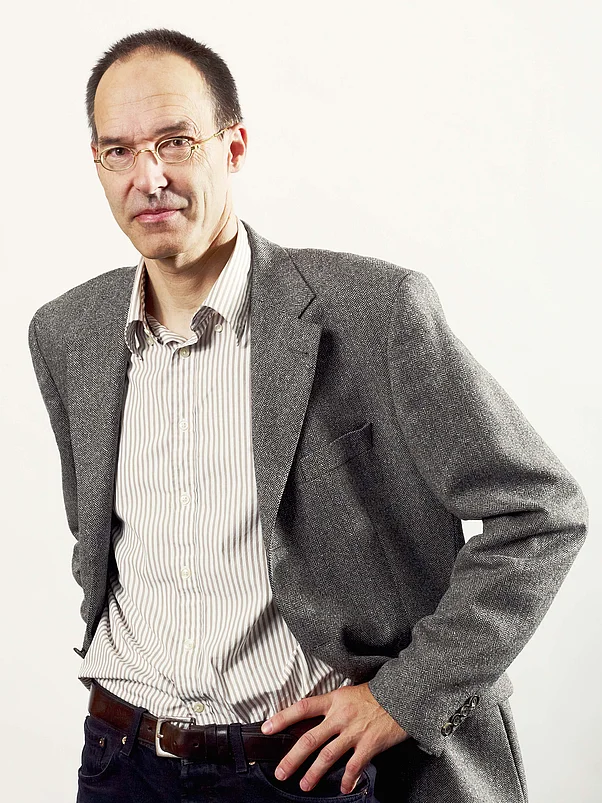
Prof. Dr. Benno Stein
Professur Intelligente Informationssysteme
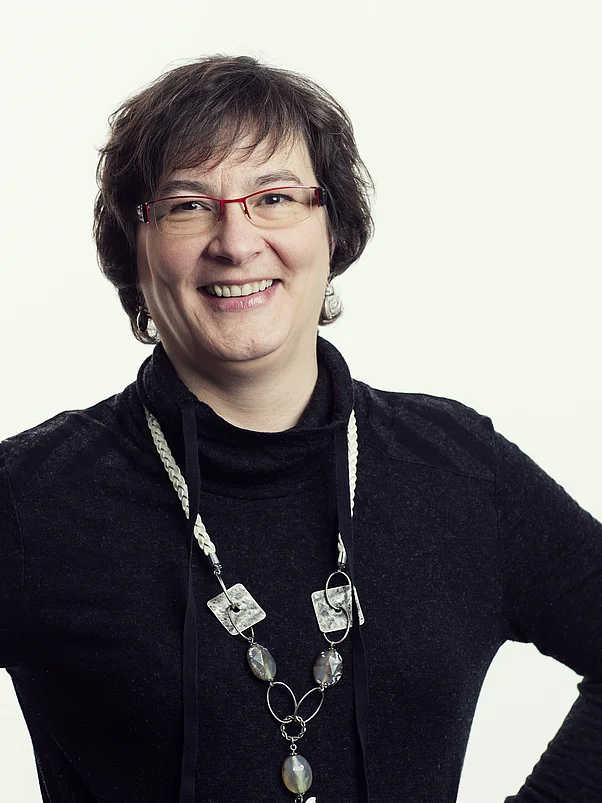
Prof. Dr. Eva Hornecker
Professur Human-Computer Interaction
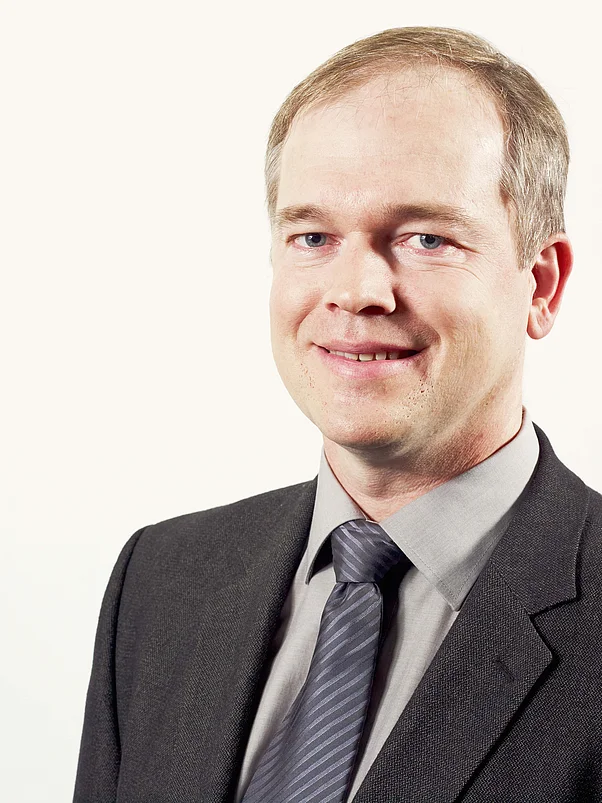
Prof. Dr. Volker Rodehorst
Professur Computer Vision in Engineering

Prof. Dr. Jan Oliver Ringert
Professur Software Engineering
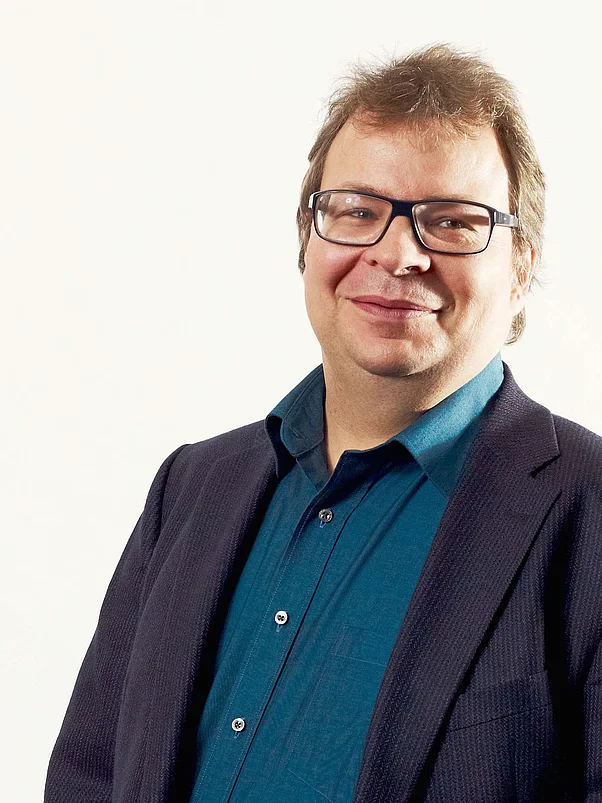
Prof. Dr. Stefan Lucks
Professur Informationssicherheit und Kryptographie
Prof. Dr. Bernd Fröhlich
Professur Virtuelle Realität und Visualisierung

Jun.-Prof. Dr. rer. nat. Robert P. Spang
Juniorprofessur Usability
Dr. Andreas Jakoby
Dozentur Algorithm Engineering
Jun.-Prof. Dr. Maurice Jakesch
Juniorprofessur Computational Social Science
Programme Structure
The master’s programme Computer Science for Digital Media comprises lectures, tutorials, seminars, two comprehensive student research projects as well as a master’s thesis for which students can choose between various specialised fields. During the first and third semester, students undertake research projects (15 ECTS each) in small groups of 3-6 students, which can be selected from a wide variety of topics offered by the different professorships. A large elective module (24 ECTS) spanning the second and third semester allows students to further specialise in advanced topics of computer science, mathematics or master’s courses from other fields. The third semester is also an ideal semester to be spent abroad, since it offers greater flexibility with respect to the choice of classes. The fourth and final semester is reserved for conducting the master’s thesis project.
The standard duration of studies for the Computer Science for Digital Media master’s programme is four semesters leading to the award of a Master of Science degree. All master’s courses are offered in English. Basic English is spoken nearly everywhere, since the historic city of Weimar attracts many visitors from all over the world. However it is useful to acquire some knowledge of the German language to simplify your daily life. Teaching and research assistantships as well as other jobs are readily available at the university and with local companies. The Student Services and the Student Council support students in finding jobs.
Practical Relevance
Current Research Topics
The internationally research-strong professorships provide you with in-depth theoretical foundations complemented by highly topical research questions and results. Our students are regularly involved in research and development projects as part of their project work and theses, and as student assistants.
Key Qualifications
The Weimar project studies offer you a framework to propose, realise and defend your first independent research developments. In doing so, you will learn to work independently, team-oriented and solution-oriented.
Labs
In our 2016 graduate survey, respondents rated access to computing services, availability of lab space and teaching and learning spaces, and lab space facilities as above average compared to other computer science degree programmes.
These laboratories are available to you during your studies:
- Electrical Engineering Lab (Lectureship in Networked Media)
- Virtual Reality Lab (Chair of Virtual Reality Systems)
- Networked Media Lab (Lectureship in Networked Media)
- Compvis Lab (Chair of Computer Vision in Engineering)
- Web Technology Lab (Chair of Content Management and Web Technologies)
- Mobile Media Lab (Chair of Mobile Media)
- Gfx Lab (Chair of Graphic Data Processing)
- Media Security Lab (Chair for Media Security)
- WinuX pool
- LiNT Pool
For research and final theses, the following state-of-the-art laboratories are also available in the Digital Bauhaus Lab on approx. 300 m2:
- User Interface Development Lab
- Human-Computer Interaction Lab
- Computer Vision Lab
- Computer Graphics Lab
- Virtual Reality Lab
- Multi-User 3D Display
- Visual Analytics Display
Supervision Ratio
The chairs are staffed with two or three doctoral students by the faculty and in most cases have other project-funded staff who also supervise projects and theses. This results in an excellent supervision ratio with approx. 30 first-year students per year and over 30 staff members as well as 8 professors, which leads to direct and intensive contact between teachers and students.
Research Orientation and Student Publication Activity
Two further indications of the research orientation of the degree programme are the student publications and the activities after graduation in the academic or research-related environment: In the student research projects and from the final theses of the Master's programme, publications are often already produced at national and international conferences, in which our students are significantly involved. In addition, a significant proportion of the graduates of recent years go on to do doctorates at professorships in Weimar and at other universities in Germany and abroad.
Application Procedure
Our English-language Master's programme »Computer Science for Digital Media« can be started in either the summer or winter semester.
If you obtained your Bachelor's degree within the European Union (EU), you can submit your application online to us by the end of March or the end of September of the current year
- Application deadline for the winter semester: 30 September
- Application deadline for the summer semester: 31 March
Prospective students who have not obtained their first degree in the European Union (EU), please apply via www.uni-assist.de.
- Application deadline for the summer semester: 15 January
- Application deadline for the winter semester: 15 July
The prerequisite for admission to the Computer Science for Digital Media degree programme is a relevant Bachelor of Science degree. Relevant courses of study are computer science, computer engineering, media informatics, information technology, software engineering, or mathematics as well as other technical and scientific courses of study with a computer science focus. If the converted credit-weighted grade point average of your Bachelor's degree in the German system are 2.0 or better, your chances of admission are good.
The bachelor's thesis must also be uploaded as part of the application to enable the admissions committee to assess the applicant's academic qualifications. Other written work in the form of publications or high-quality project reports are also helpful (see Application FAQs).
Admission Procedures & Requirements
If you have any questions about your language certificates, please contact: studium[at]uni-weimar.de.
The following applies to German-speaking applicants:
You can prove level B2 of the »Common European Framework of Reference for Languages« (CEFR) for the language English through:
- The submission of your school leaving certificate proving English lessons for at least 6 years (from grade 7) until graduation (Abitur). The final grade, if applicable the average grade of the last two years, must be at least grade 2 (good) or 10 points;
or
- The submission of proof of a successfully completed English-language Bachelor's degree.
If you cannot prove your English language skills in this way, please present one of the following language certificates, which must not be older than two years (comparable certificates are subject to individual assessment):
| English Language Certificate | Result/Level | Organisation |
TOEFL: Test of English as a foreign language The TOEFL code of Bauhaus-Universität Weimar is 8968. It is sometimes listed under "Bauhaus-Universitaet Weimar" or "Bauhaus University Weimar" | at least 85 Points | www.ets.org |
| IELTS: International Englisch Language Testing System | Minimum Grade 6,5 IELTS (the score of each test component must be at least 6,0) | www.ielts.org www.britishcouncil.de |
| English for Speakers of other languages (ESOL) (Cambridge University) | First Certificate in English (FCE) | www.cambridgeesol.de |
The following applies to international applicants:
(Although you do not have to provide official proof of German language skills, we recommend that you learn some language basics before coming to Weimar).
You can prove level B2 of the "Common European Framework of Reference for Languages" (CEFR) for the language English by:
- presenting proof of having successfully completed an English-language Bachelor's degree in an English-speaking country (USA, Canada, Great Britain, New Zealand, Australia, ...).
- If you cannot prove your English language skills in this way, please present one of the following language certificates, which must not be older than two years (comparable certificates are subject to individual assessment):
| English Language Certificate | Result/Level | Organisation |
TOEFL: Test of English as a foreign language The TOEFL code of Bauhaus-Universität Weimar is 8968. It is sometimes listed under "Bauhaus-Universitaet Weimar" or "Bauhaus University Weimar" | Min. 85 Points |
|
| TOEFL: computer based (0-300 Pkt.) | Min. 213 Points |
|
| IELTS: International Englisch Language Testing System | Minimum Grade 6,5 IELTS (the score of each test component must be at least 6,0) | www.ielts.org www.britishcouncil.de |
| English for Speakers of other languages (ESOL) (Cambridge University) | First Certificate in English (FCE) |
|
| PTE: Pearson Test of English | Min. 70 Points | www.pearsonpte.com |
Application FAQs
What background do I need for the Computer Science for Digital Media program?
What background do I need for the Computer Science for Digital Media program?
Typically, applicants have a Bachelor of Science in Computer Science or a related field (e.g. Software or Medieninformatik/Computer Science for Digital Media), but Mathematics and Engineering are also possible.
When we review your application, we will check if you have completed a sufficient number of Mathematics and Computer Science courses:
- Mathematics and Computer Science amounting to the equivalent of at least 90 ECTS points (approx.)
- Mathematics amounting to at least 15 ECTS points
- Computer Science amounting to at least 45 ECTS points
We also consider the specific courses you have taken; have you acquired certain core competences that we consider vital for you to succeed in our programme? These include solid programming skills and basic concepts in Discrete Mathematics, Software Engineering and Theoretical Computer Science.
If you fail to satisfy these requirements only narrowly, we may still accept your application, but with certain stipulations - namely one or two supplementary courses in order for you to catch up with the other students.
What criteria are your basis for accepting or rejecting an application?
What criteria are your basis for accepting or rejecting an application?
Assuming you have met our basic requirements regarding the courses you have taken (see above), the uploading of the Bachelor's Thesis and the English certificate (see below), and your cumulative GPA (at least 2.1 or better in the German grading system), your application will be considered for further review.
Otherwise, your application will be rejected without further consideration.
Then we first consider the following two questions:
1. Does your bachelor’s thesis (or other academic papers you have written) demonstrate your ability to conduct independent academic research?
2. How many Computer Science courses did you take during your previous studies, how advanced were these courses, and what were your final grades?
After considering these two questions, we have often reached either a positive or a negative decision. If we are still in doubt, however, we will consider your references and letter of motivation (you are not required to submit these - see below), together with your English scores.
Should I submit a letter of motivation, or one or more references?
Should I submit a letter of motivation, or one or more references?
You are not required to do so. However, in some cases, it may help.
If we are on the fence in deciding about your application, convincing references, or a well-written letter of motivation may well work in your favour.
I have professional experience in ... When you consider my application, do you take my professional experience into account?
I have professional experience in ... When you consider my application, do you take my professional experience into account?
Yes, we do. For example, although we may reject your application if you have taken too few courses on Computer Science during your previous studies, you can compensate for this to some degree by proving evidence of some job experience closely related to Computer Science.
What IELTS Score for English do I need?
What IELTS Score for English do I need?
We require an overall score of at least 6.5 in the IELTS (the score of each test component must be at least 6,0). Applicants with a lower score will not be considered.
In general, we expect adequate passive and active language proficiency in both written and spoken English. You will need this to successfully follow the programme.
It goes without saying that your IELTS score must still be valid.
IELTS is the most commonly used language certification, but alternative language certificates are also possible. See the 'Application' information on our webpage.
I studied in English, do I still need to provide a language certificate?
I studied in English, do I still need to provide a language certificate?
We are sorry, but the teaching language is not sufficient for us. Only if the country where you studied is English-speaking is no language certificate needed. If in doubt (e.g. you have already studied for several years in an English-speaking country), please contact us.
If you have any further questions about language certification, please contact Johanna Merian at our Department of Studies and Education / International Applications: studium[at]uni-weimar.de.
Am I eligible? I have written neither a Bachelor's thesis nor any other kind of academic paper.
Am I eligible? I have written neither a Bachelor's thesis nor any other kind of academic paper.
We are sorry, but you are not eligible.
Am I eligible? My bachelor degree has a cumulative GPA of ‚X’.
Am I eligible? My bachelor degree has a cumulative GPA of ‚X’.
There is a threshold. If your cumulative GPA is worse than 2.1 (in the German grading system), we will not consider your application.
Beyond that, your cumulative GPA is of no relevance to your application.
Am I eligible? Here are my University Transcript and/or my Bachelor's thesis!
Am I eligible? Here are my University Transcript and/or my Bachelor's thesis!
Please bear in mind that deciding on eligibility is a time-consuming process, which we only perform for prospective students who actually apply.
Am I eligible? I have a degree in ...
Am I eligible? I have a degree in ...
We care more about the courses you have taken than about the title of the degree.
Am I eligible? I have taken the following courses ...
Am I eligible? I have taken the following courses ...
Please bear in mind that deciding on eligibility is a time-consuming process, which we only perform for prospective students who actually apply.
Career Prospects
Our graduates find employment in the R&D departments of companies in the automotive, telecommunication, software, gaming and animation industry, as well as at academic institutions in Germany and overseas. A specialisation in Computer Science with focus on media opens the door for employment and research in innovative areas such as system development, algorithm development, data analysis, data mining, scientific visualisation, image processing, physical simulation, interface development and testing and security protocols development.
Contact with Attractive Employers Worldwide
If you achieve very good marks, your tutors can gladly help you to land your dream job at a leading IT company: our professors are in contact with attractive employers worldwide, including Google, Adobe, IBM, Volkswagen and Zeiss.
Establish a Start-up
Want to turn your project into a business? The Bauhaus-Universität Weimar has its very own start-up hub: »neudeli« helps students and alumni interested in setting up their own company to make their business idea a reality.
Belgium
City: Brussels
University: Vrije Universiteit Brussel
Faculty: Faculty of Sciences and Bioengineering
Places: 2
Language: English/Dutch
Support: Prof. Dr. Eva Hornecker
Canada
City: Toronto
University: York University
Faculty: School of the Arts, Media, Performance & Design
Places: 1
Language: English
Support: Prof. Dr. Bernd Fröhlich
Czech Republic
City: Brno
University: Brno University of Technology
Faculty: Faculty of Information Technology
Places: 2
Language: English/Czech
Support: Prof. Dr. Stefan Lucks
France
City: Paris
University: Université Gustave Eiffel
Faculties:
- ESIEE PARIS (L'école de l'innovation technologique: Image - Multimedia - Audiovisual - Communication (IMAC)
- Institut d’électronique et d’informatique Gaspard-Monge
Places: 1
Language: French/English
Support: Prof. Dr. Eva Hornecker
Portugal
City: Aveiro
University: Universidade de Aveiro
Faculty: Department of Mathematics
Places: 1
Language: Portuguese
Support: Prof. Dr. Björn Rüffer
Spain
City: Girona
University: Universitat de Girona
Faculty: Escola Politècnica Superior
Places: 2
Language: Spanish/Catalan
Support: Prof. Dr. Charles Wüthrich
City: Malaga
University: Universidad de Malaga
Faculty: Departamento de Tecnologia Electronica
Places: 2
Language: Spanish/English
Support: Prof. Dr. Bernd Fröhlich
Sweden
City: Karlskrona
University: Blekinge Tekniska Högskola
Faculty: Blekinge Institute of Technology
Places: 1
Language: Swedish/English
Support: Prof. Dr. Bernd Fröhlich
Ansprechpartnerin

Annette Reese
International Counsellor Faculty of Media
Course Guidance
Prof. Dr. Benno Stein
Professur Intelligente Informationssysteme