
GMU:Diy biolab drivers license SoSe26/Daria Lukianchuk: Difference between revisions
No edit summary |
No edit summary |
||
| (3 intermediate revisions by the same user not shown) | |||
| Line 2: | Line 2: | ||
In the second lecture of our 'Diy biolab drivers license' course, students saw live how slime mold transfers nutrients within its body. Firstly the flow goes in one direction, after a while stops and then moves in another direction. Since this is how a slime mold grows and distributes nutrients to every part of its body, I wondered: what if the slime mold were to consume multicolored food—would it change its color as a result? And what if there were several different colors involved? Would distinct color boundaries be visible, or would there be soft transitions? Or would the slime mold simply turn a single, uniform color? | In the second lecture of our 'Diy biolab drivers license' course, students saw live how slime mold transfers nutrients within its body. Firstly the flow goes in one direction, after a while stops and then moves in another direction. Since this is how a slime mold grows and distributes nutrients to every part of its body, I wondered: what if the slime mold were to consume multicolored food—would it change its color as a result? And what if there were several different colors involved? Would distinct color boundaries be visible, or would there be soft transitions? Or would the slime mold simply turn a single, uniform color? | ||
That's exactly | That's exactly why I started my experiments. For that I needed: | ||
* slime mold | * slime mold | ||
| Line 11: | Line 11: | ||
* camera | * camera | ||
My final goal is to film the process of growing with camera. With the video/timelapse It will be very clear to see how slime mold | My final goal is to film the process of growing with camera. With the video/timelapse It will be very clear to see how slime mold change colors. | ||
== First experiment (08.05) == | == First experiment (08.05) == | ||
| Line 32: | Line 32: | ||
File:Food paint description (contains sugar).jpg|Composition of food colorings (primarily made from sugar) | File:Food paint description (contains sugar).jpg|Composition of food colorings (primarily made from sugar) | ||
File:Placing everything in Petri dish.jpg|Placing everything in Petri dish | File:Placing everything in Petri dish.jpg|Placing everything in Petri dish | ||
</gallery>/// | </gallery>When Petri dished were ready, it was the time to prepare camera set-up for timelapse filming. After reading some manuals and instructions I was able to set settings, that camera makes one photo each minute. For the first experiment I decided to make 48 frames (48 minutes of filming), which in the end will be 2 seconds video. My teacher also suggested to feed mother culture to make it stronger for the future.<gallery> | ||
File:Camera stand set-up.jpg|Camera set-up with placed Petri dishes | |||
File:Feeding Mother Culture for the future (top view).jpg|Feeding Mother Culture to make it stronger | |||
File:Feeding Mother Culture for the future.jpg | |||
</gallery>After filming I exported it to my laptop and made a video out of the footage. By the way, instead of 48 photos, there were somehow 96 on the memory card—and on the video itself, constant flashes were visible. I saw in the camera setting "Anti-flickering mode", so maybe I need to enable it next time. | |||
[[File:First experiment timelapse.mp4|thumb|center]] | |||
== Second Experiment (11.05) == | |||
Since I already understood what my workflow is like, now I could create more precise plan. I wanted to film around 11 hours of timelapse (660 frames), so I'll stay in the BioLab almost the whole day. When I arrived at 6am I wanted to check two Petri dishes from my first experiment and then decide if I'll continue with them or create new ones. | |||
In Petri dishes I noticed that slime mold changed color only in two spots: with blue and green colors, but blue one was the most visible. I assume, that place with red drop was hard ro reach for the slime mold (drops were on top of oat flakes), and place with the yellow one... I don't even know actually if it's natural color of the culture or not. But the first experiment was exactly for proving some of my concerns and to understanf what to do next. | |||
I decided to prepare everything once again, because this material won't give me result that I want in the end. Also, my plan with using strong culture failed —there were mold inside. That's why I'll use slime mold from the first experiment.<gallery> | |||
File:First try after three days.jpg|First subject after three days | |||
File:First try after three days (close-up).jpg | |||
File:Mold in the mother culture after three days.jpg|Mold in Mother Culture after three days | |||
</gallery> | |||
I repeated all the steps from the first experiment. The only thing that was different is a way of coloring. This time, instead of yellow, I'll mix orange color (hopefully it will be more visible in the end), and I won't add drops of dye on top of the oat flakes: instead, I'll dye them completely. That way, the slime mold for sure will cover the dye.<gallery> | |||
File:Preparing agar again.jpg|Preparing agar again | |||
File:Coloring oat flakes.jpg|Coloring oat flakes | |||
File:Prepared second try.jpg|Prepared second try | |||
</gallery> | |||
/// | |||
Latest revision as of 07:16, 11 May 2026
Slime Mold and Colored Nutrients
In the second lecture of our 'Diy biolab drivers license' course, students saw live how slime mold transfers nutrients within its body. Firstly the flow goes in one direction, after a while stops and then moves in another direction. Since this is how a slime mold grows and distributes nutrients to every part of its body, I wondered: what if the slime mold were to consume multicolored food—would it change its color as a result? And what if there were several different colors involved? Would distinct color boundaries be visible, or would there be soft transitions? Or would the slime mold simply turn a single, uniform color?
That's exactly why I started my experiments. For that I needed:
- slime mold
- Petri dishes
- oat flakes
- agar
- food coloring
- camera
My final goal is to film the process of growing with camera. With the video/timelapse It will be very clear to see how slime mold change colors.
First experiment (08.05)
During the first try it was important for me to understand my workflow in the lab and already test my idea practically.
First of all medium for slime mold had to be prapared. I'll use 2% agar solution.
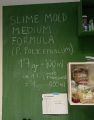
Formula in BioLab for slime mold medium
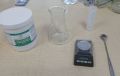
All ingredients are prepared. Agar-agar, laboratory glassware for measurement and mixing, scale and spoon

Agar and water mixed together


After that agar must be heated and then poured into Petri dishes.
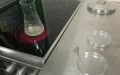
Heating agar
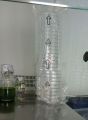
Sterile Petri dishes

Two Petri dishes filled with agar


When agar medium is ready it's time to put slime mold, oat flakes, and food coloring inside. Around two weeks before the experiment some of the students took slime mold with them to home, and I was one of them. During this time slime mold grew very well, and I'll use it as "mother culture" for my experiment.
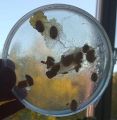
"Mother culture" for my experiment
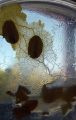


I took some parts from the Mother Culture and placed them in two Petri dishes. For the coloring process I took liquid food coloring (four colors) and judging by their composition, I assume that slime mold should like this—since the dye consists primarily of syrup and sugar. After placing slime mold and oat flakes inside Petri dishes I made a couple of color drops on top of flakes.

Taking part of the Mother Culture
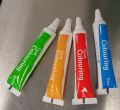
Liquid food coloring
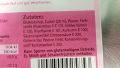
Composition of food colorings (primarily made from sugar)
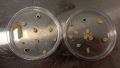
Placing everything in Petri dish


.jpg)

When Petri dished were ready, it was the time to prepare camera set-up for timelapse filming. After reading some manuals and instructions I was able to set settings, that camera makes one photo each minute. For the first experiment I decided to make 48 frames (48 minutes of filming), which in the end will be 2 seconds video. My teacher also suggested to feed mother culture to make it stronger for the future.
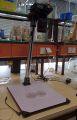
Camera set-up with placed Petri dishes

Feeding Mother Culture to make it stronger


.jpg)

After filming I exported it to my laptop and made a video out of the footage. By the way, instead of 48 photos, there were somehow 96 on the memory card—and on the video itself, constant flashes were visible. I saw in the camera setting "Anti-flickering mode", so maybe I need to enable it next time.
Second Experiment (11.05)
Since I already understood what my workflow is like, now I could create more precise plan. I wanted to film around 11 hours of timelapse (660 frames), so I'll stay in the BioLab almost the whole day. When I arrived at 6am I wanted to check two Petri dishes from my first experiment and then decide if I'll continue with them or create new ones.
In Petri dishes I noticed that slime mold changed color only in two spots: with blue and green colors, but blue one was the most visible. I assume, that place with red drop was hard ro reach for the slime mold (drops were on top of oat flakes), and place with the yellow one... I don't even know actually if it's natural color of the culture or not. But the first experiment was exactly for proving some of my concerns and to understanf what to do next.
I decided to prepare everything once again, because this material won't give me result that I want in the end. Also, my plan with using strong culture failed —there were mold inside. That's why I'll use slime mold from the first experiment.
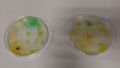
First subject after three days


Mold in Mother Culture after three days

.jpg)

I repeated all the steps from the first experiment. The only thing that was different is a way of coloring. This time, instead of yellow, I'll mix orange color (hopefully it will be more visible in the end), and I won't add drops of dye on top of the oat flakes: instead, I'll dye them completely. That way, the slime mold for sure will cover the dye.
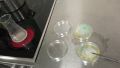
Preparing agar again

Coloring oat flakes
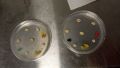
Prepared second try


///