

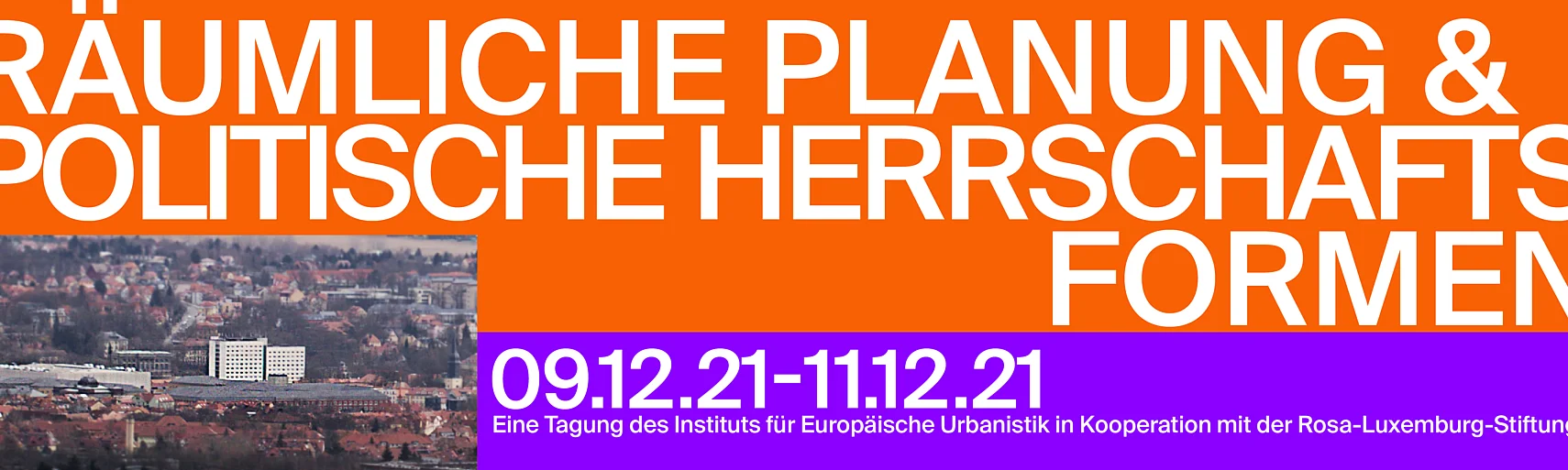
Programm zum Herunterladen (Stand Dezember 2021)
Urban and spatial planning in the Federal Republic of Germany is based on a parliamentary democracy and a capitalist market economy. This also applies to many other countries. That is why such socio-political conditions are at the heart of our academic and professional practice. However, even a glance at other European countries makes us realise that such conditions cannot be taken for granted. If we take it a step further and examine Urban Design and settlement patterns in today’s Federal Republic of Germany and most other European countries, we are reminded that, in the past, the combination of parliamentary democracy and a capitalist market economy was merely one of many forms of political rule. Our towns, landscapes and regions still bear the hallmarks of other, sometimes entirely different, conditions.
In the training of professionals who will assume responsibility in the various fields of spatial planning and research, reference is repeatedly made to the socio-political determinants of Urban Design, regional planning and territorial organisation. How these determinants – which, after all, encompass not only the domestic political system but also economic, cultural, demographic and, at times, even military-strategic conditions, to name but a few – manifest themselves in spatial planning is, at best, merely hinted at. This may be explained by the fact that the link between socio-political factors and spatial planning has been researched only sporadically.
Yet international planning historiography has made great strides in recent years. Recent publications emphasise the geographical and cultural diversity of spatial planning, as well as the need not to regard one’s own context as self-evident or universally applicable. However, the relationship between forms of governance and planning usually only becomes a central research question in the context of spectacular representational buildings. Far more often, spatial planning is explained solely in terms of its own dynamics. This leaves open the question of how the products of planning – such as drafts, planning documents and large-scale development programmes, as well as urban and territorial structures – are shaped by social policy. Less attention is paid to how these products came about, what professional and socio-political constellations gave rise to them, how the specialist planning disciplines were deployed in the process, what intentions spatial planning was required to follow or obey, and what consequences planning measures had. We learn very little about the extent to which the discipline’s own internal logic came into play, or to what extent experts invoked their knowledge and sense of responsibility to correct the course or even to oppose it intellectually and actively.
The search for what is distinctive about the production of cities and space under specific political systems is, of course, complicated by obvious synchronicities and convergences in functional programmes, urban morphology and settlement structures, which can be explained in part by the stage of industrialisation, international competition and the lively professional exchange across all borders. Is it therefore irrelevant under which socio-political conditions planning takes place?
Our symposium combines exploratory curiosity with inductive casuistry. We draw on the findings of research projects – some of which were carried out at our university – that have examined spatial planning under very different forms of governance. We also consult those responsible for the practical management of the structures and objects left behind by a wide variety of forms of government. We group the various case studies by historical period and leave the task of categorisation and classification to the discussion and subsequent reflection.
The symposium is structured into four sections. As a first step, we explore the relationship between spatial planning and the dictatorial forms of government that emerged from the 1920s onwards. The second section examines the specific characteristics of spatial planning in state-socialist societies, which defined themselves in the 20th century as a counterpart to capitalism and passed through decades – one of them still exists today. The third section builds on this: state socialism gave rise to Urban Design and territorial structures, patterns of distribution in both the productive and socio-spatial spheres, as well as a spatialcultural understanding, all of which were, after 1990, re-assimilated into capitalist conditions on behalf of ‘transformation’ and have since given rise to diverse practices and discourses of spatial development and spatial development policy. Finally, in the fourth section, we turn our attention to the way in which, under the changing conditions of the respective politics of the past, examples of urban design heritage—which were erected as explicit symbols of past forms of rule—are treated.
The conference languages are German and English. Victoria Grau and Jannik Noeske will take turns chairing the entire event.

Programme:
Thursday, 9 December:
12.30 Doors open
13.00 – 14.30 Book launch
Opening address Barbara Schönig,
15.00 Director of the Institute for European Urban Studies; Bauhaus-Universität
Weimar
Introduction Spatial Planning and Politics – 15
.10 Questions from a Weimar perspective Max
Welch Guerra, director of the Bauhaus Institute of History and
Theory of Architecture and Planning; Bauhaus-Universität Weimar
Keynote Urban Design and Dictatorship from a European Perspective
15.35 Harald Bodenschatz, Centre for Metropolitan Studies, TU Berlin
Coffee
break 16.35
I
Spatial Policy and Governance in the Mid-20th Century
17.00
- The Economisation of Power: Spatial Politics in Central and Eastern Europe 1938–1945
Richard Němec, Institute of Art History, University of Bern; Office for the Preservation of Historical Monuments, Canton of Thurgau - Urban Design as an expression of the new middle classes under the Portuguese dictatorship, 1932–1955
Christian v. Oppen, Centre for Metropolitan Studies, TU Berlin
The Diversity of Functions in Urban Planning during the Early Franco Era 1938–1959
Max Welch Guerra, Bauhaus-Universität Weimar
Commentary Victoria Grau, Bauhaus-Universität Weimar
18.45
Discussion
18.55
Friday, 10 December
II
Spatial Policy under State Socialism
09.30
- ČSSR – Prague Panel Housing Estates from High Modernism to Postmodernism
Petr Roubal, Institute of Contemporary History, Academy of Sciences of the Czech Republic - Dreams and Spaces of a Revolution – Urban Design and Architecture in Cuba since 1959
Manuel Cuadra, National University of Engineering, Lima
Coffee break
10.30
Presentation Grand Plans and Small Interventions. Old Town Regeneration and the Planned Economy in the
11.00 GDR.
Jannik Noeske, Bauhaus-Universität Weimar
Commentary Arnold Bartetzky, Leibniz Institute for the History and Culture
11.30 of Eastern Europe, Leipzig
Discussion
11.40
Lunch break
12.10
III
The Post-Socialist City – Spatial Policy and the Reintroduction of Capitalist Conditions
13.45
- Changing political systems and changing urbanism after socialism
Mariusz Czepczyński, urbanHIST – History of European Urbanism in the 20th Century; Department of Spatial Management, University of Gdańsk
- The Reinvention of Urbanism as a Political Project – Urban Renewal in Contemporary Russia
Daniela Zupan, Institute for European Urban Studies, Bauhaus-Universität Weimar
- National Capital: The Politics of Urban Heritage in Budapest After 2010
Marcell Hajdu, Graduate College on Heritage and Identity, Bauhaus-Universität Weimar
- Berlin’s Urban Planning: A Retrospective on 30 Years of Convergence.
Katrin Lompscher, former Senator for Urban Development and Housing, Berlin
Coffee break
15.45
Commentary Florian Urban, Glasgow School of Art
16.15
Discussion
16.25
Break
17.00
Keynote New Tendencies in Planning History
17.30 Carola Hein, Vice-President of the International Planning History Society; Delft University of Technology
Trombones and trumpets
18.30
Saturday, 11 December
IV
Outstanding symbols of Urban Design during dictatorial rule today
09.00
- Italy’s Approach to its Fascist Legacy: A History of Development
Daniela Spiegel, Anhalt University of Applied Sciences
- Valle de los Caídos in Spain: Construction, Use and Interpretation of a Gigantic Legacy of the Franco Dictatorship, 1939–2021
- Piero Sassi, Bauhaus-Universität Weimar
- Nuremberg: The Reich Party Rally Grounds in the Changing Landscape of European Remembrance Culture
Florian Dierl, Director of the Documentation Centre for the Reich Party Rally Grounds, Nuremberg
Commentary Hans-Rudolf Meier, Bauhaus-Universität Weimar
10.30
Discussion
10.40
Closing lecture: Spatial Planning and Politics – An Initial
11.15 Summary
Max Welch Guerra, Bauhaus-Universität Weimar
Refreshments, coffee
11.45
Our symposium would not have been possible without the groundwork laid by a wide range of relevant research activities at the Bauhaus-Universität Weimar, in which both the Institute for European Urban Studies and the Bauhaus Institute of History and Theory of Architecture and Planning have been and continue to be involved. The most important research projects among these are:
Urban Design under Franco and Salazar: Urban Production in Iberian Dictatorships within a European Context, Bauhaus-Universität Weimar and Technical University of Berlin, 2014–2018; funded by the German Research Foundation (DFG)
Research Training Group ‘Identity and Heritage’, Bauhaus-Universität Weimar and Technical University of Berlin, 2016–2021; funded by the German Research Foundation (DFG)
urbanHIST – History of European Urbanism in the 20th Century, Bauhaus-Universität Weimar (BUW, Germany), Blekinge Institute of Technology (BTH, Sweden), University of Valladolid (UVa, Spain) and Pavol Jozef Šafárik University in Košice (UPJŠ, Slovakia), 2016 to 2020; Funding: the European Union’s Horizon 2020 research and innovation programme, (ITN) European Joint Doctorate under the Marie Skłodowska-Curie Actions
Stadtwende. Urban regeneration at a turning point – the significance of citizens’ initiatives against the decline of the old town for the transformation in the GDR, Bauhaus-Universität Weimar, University of Kassel, Technical University of Kaiserslautern, IRS-Leibniz Institute for Spatial Research, Erkner; Technical University of Kaiserslautern, 2019–2022; funded by the Federal Ministry of Education and Research for research