

Thesis Topic - Designing Empathy
A participatory platform where AI-augmented collaborative urban design fosters mutual understanding and empathy between stakeholders.
Dr.-Ing. Martin Bielik · Chair of Informatics in Architecture and Urbanism · Bauhaus-Universität Weimar
The planner who squeezes a bike lane, a loading zone, and a school crossing into the same street knows exactly why none of them turned out the way anyone asked. Nobody else in the room does.
Summary
Urban participation today asks people to choose between options someone else designed. Nobody experiences the trade-offs firsthand — the parent who wants a car-free school zone never confronts the elderly resident who needs parking nearby. Conflicts stay invisible, and planners get blamed for compromises no one agreed to.
This thesis builds a participatory platform where stakeholders design their own proposals using AI generation tools — and in doing so, discover that space is finite and every choice costs someone else something. The platform is not a co-design tool that produces the final intervention; the design activity is the method. The measure of success is not better designs but measurable shifts in how participants understand each other's needs.
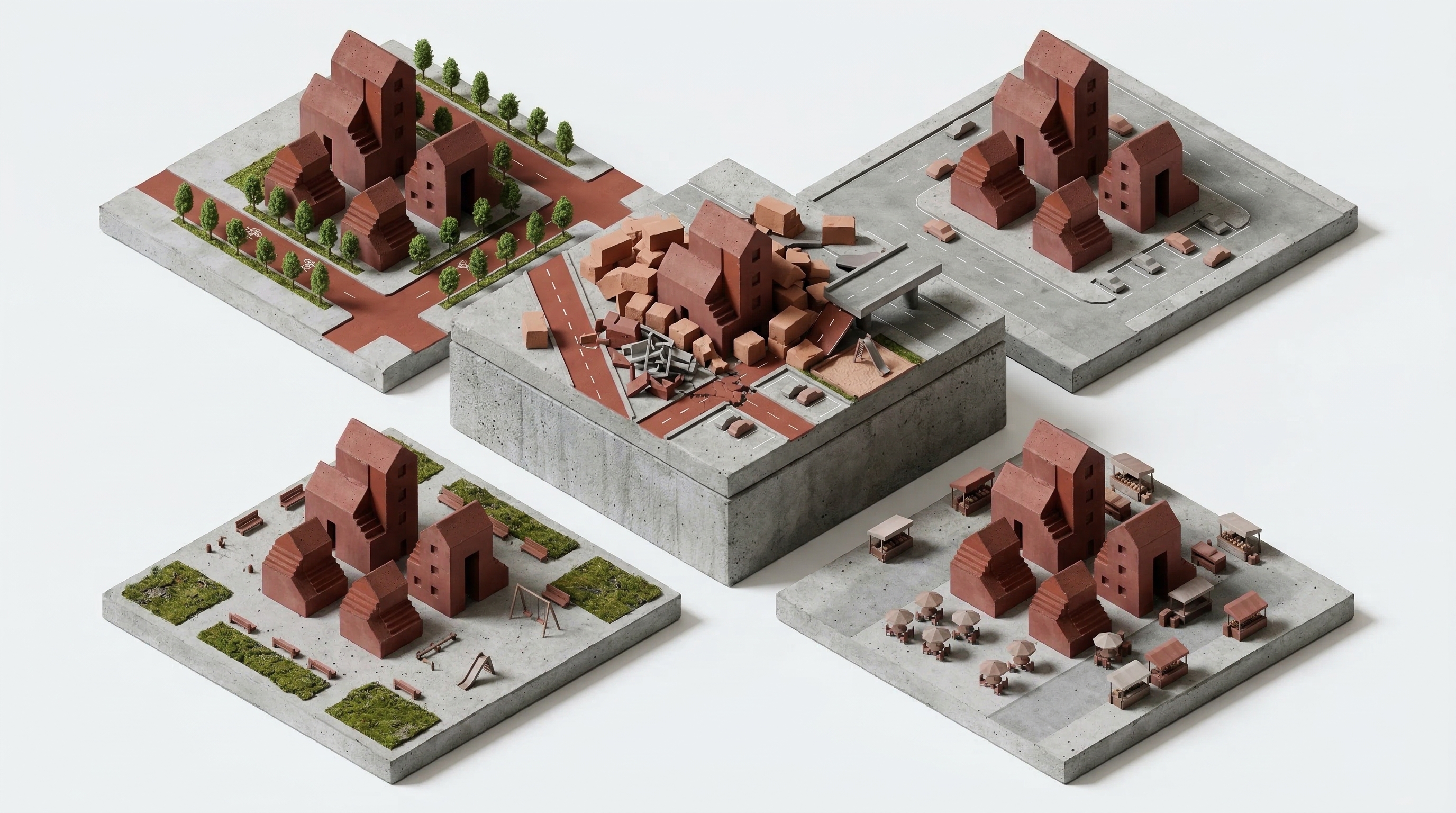
Description
1. Problem Statement
A shop owner wants delivery access, a parent wants a car-free school zone, an elderly resident wants parking close to home, a teenager wants space to hang out. Each need is legitimate. Each, pursued fully, makes another impossible. But in current participation processes — surveys, public hearings, voting on pre-made options — these conflicts stay invisible. People advocate for their own priorities without ever encountering the spatial reality that connecting them requires compromise. The result: stakeholders leave the process feeling unheard, planners are blamed for trade-offs nobody agreed to, and the deeper question — what do the others actually need, and why can I not have everything? — is never asked.
Generative AI can produce anything from photorealistic images of cats to architectural visualizations to urban design proposals. These models are not equally capable in every domain, but they are improving fast. This thesis speculates on a near future where they are good enough to turn spatial requirements into design proposals — a capability that has always required professional training. If anyone can generate a design from a set of needs, participation no longer has to mean choosing from pre-made options. Stakeholders can design their own proposals — and in doing so, discover firsthand that space is finite, that priorities conflict, and that understanding what others need is the prerequisite for any shared solution. The point is not to replace the designer — a professional will still refine the final outcome. The point is that they will do so for a community that actually understands why compromises exist and what they cost each other. The core thesis question is not technical but social: can the act of designing, supported by the right rules and feedback, build mutual understanding between people who share a space but not a perspective?
2. Expected Outcome
A working participatory design platform, tested with real stakeholders in a real urban design context. An important distinction: this platform is not a co-design tool that produces the final intervention. The design activity is the method — the goal is to transform how stakeholders understand each other's needs. The designs they produce are means, not ends. A professional designer still shapes the final proposal — but now for people who genuinely understand why trade-offs exist and what they cost their neighbors. The platform succeeds not when it produces a good design, but when participants leave with a fundamentally different understanding of what others need and why.
The student must define and deliver four things:
1. The right problem. A concrete urban design situation — a street, a public space, a contested lot — where multiple stakeholder groups have genuinely different spatial needs and lack understanding of each other's priorities. The student identifies the stakeholders, maps their conflicting needs, and argues why this situation is a good test case.
2. The rules of participation. Giving everyone a design generator is not enough — the process needs structure. The student must define:
- Who participates, and in what roles?
- How are people allowed to design? Does everyone get a limited number of design actions, or can anyone do whatever they want? Can you modify what someone else proposed?
- Can stakeholders see and respond to each other's proposals? How and when?
- What sequence of steps guides people from "here is what I want" to "here is what we all need"?
3. The feedback design. This is a core design challenge of the thesis. Designing alone does not guarantee understanding — people need to learn from what they do. The student must define how stakeholders receive feedback on their design actions:
- What happens when a proposal conflicts with another stakeholder's needs? How is that made visible?
- What spatial metrics, trade-off indicators, or comparisons are shown — and when? In real time, after a round, at the end?
- How does a stakeholder learn what their design choices cost someone else?
- How does the feedback shift the participant's focus from "what I want" toward "what is possible" and "what others need"?
4. The platform. A working prototype that implements the design problem, the participation rules, and the feedback mechanisms. It uses current AI generation tools as the design engine and focuses on the interaction layer: how the act of designing exposes conflicts, how feedback makes other people's needs tangible, and how the process shifts participants from advocacy to understanding.
The student tests the platform with real stakeholders and evaluates whether participation changes how people understand each other — not whether it produces better designs. The measure of success is empathy, not aesthetics: can a stakeholder articulate what someone else needs, why they need it, and what it would cost to ignore it?
3. Presentation & Portfolio Value
Final presentation: A facilitated session where reviewers experience the platform as participants — designing, encountering conflicts, and discovering what their choices cost others. Accompanied by field test results showing how participants' understanding of each other's needs changed through the process.
Career signal: This thesis demonstrates the ability to: design structured participatory processes that build mutual understanding around spatial conflicts; build interactive platforms that make complex trade-offs legible to non-experts; and facilitate real stakeholder engagement with measurable shifts in empathy and comprehension — relevant for civic tech, urban innovation labs, planning consultancies, and community-driven design.
4. Submission
Always required:
- Portfolio PDF (2 pages, A4) — visual summary of the project: the participation problem, the platform concept, key moments from the field test, and presentation-quality screenshots or diagrams.
- 30-second video reel — a shareable teaser showing stakeholders discovering each other's needs and encountering the consequences of their own proposals through the platform.
- 5-minute explainer video — walks through the problem, the participation rules, the feedback design, a field test session, and what changed in how participants understand each other.
Working prototype: The participatory design platform, deployed or runnable by the reviewer. A reviewer should be able to step through the participation process — design a proposal, see trade-off feedback, encounter another stakeholder's design.
Specification document: Describes the platform's design at a level where someone could rebuild it: the participation rules (who designs, how, in what sequence, with what constraints), the feedback mechanisms (what is shown, when, how trade-offs are made visible), and how the AI generation engine is integrated (what inputs it receives, what it produces, how proposals are compared). Not implementation documentation — the logic and design rationale.
Validation report: Documents the field test: who participated, how many sessions, what the process looked like. Reports whether participants understood trade-offs better after the process, whether they modified designs after seeing others' needs, and whether they could articulate what someone else needs and why. Method, data, and findings.
5. Requirements
Baseline: Experience with AI-assisted coding workflows; prior web development experience (the thesis centers on building a web platform — previous projects can be AI-generated); understanding of urban design and stakeholder dynamics; interest in participation, communication, and interaction design.
Acquirable during the thesis: Working with specific AI design generation tools (connecting generators, prompt engineering); interactive platform features (real-time feedback, trade-off visualization); facilitation and field testing methods.
6. Solution Space (deliberately open)
The thesis is deliberately open in how the participatory process and platform take shape. The generation engine could use image-based AI models, parametric design tools, or a combination. The participation format could be synchronous (a live workshop) or asynchronous (an online platform over days). Feedback could be quantitative (spatial metrics, coverage scores) or qualitative (narrative prompts, peer reactions). The student is encouraged to explore what works for their chosen problem and stakeholders — and to propose approaches not listed here.
7. Project Stages
- Problem & stakeholders — Select a concrete urban design situation with diverse stakeholders whose needs genuinely conflict. Map who they are, what they need, and where understanding breaks down.
- Participation rules — Define who designs, how, with what constraints, and in what sequence. How do stakeholders encounter each other's proposals? Iterate early and get input from participation experts.
- Feedback design — Define how participants learn from their actions. What makes trade-offs visible? How does a stakeholder discover what their choices cost someone else? This is a core design challenge of the thesis.
- Build the prototype — Develop the working platform using current AI tools as the generation engine. Prioritize the participation logic and feedback layer over visual polish.
- Field test — Run the participatory session with real stakeholders. The evaluation question is not "did they produce a good design?" but: Do participants understand each other's needs better than before? Can they articulate what someone else needs — and why? Do they change their own proposals after encountering the consequences for others?
- Evaluation & documentation — Analyze results. Write the thesis. Prepare the facilitated demo for the final review.
8. Keywords
participatory design, design trade-offs, stakeholder empathy, generative urban design, participation rules, feedback design, civic technology, mutual understanding
Before You Apply
Read the supervision terms and conditions — how I work, the timeline and deadlines, the consultation structure, and what is due when.
Dr.-Ing. Martin Bielik · InfAU · Bauhaus-Universität Weimar